Globalisation, an ageing population, climate change – the challenges that Europe faces on a continental level are also visible in the European regions. As a result, issues that a council in Norway is working on, for instance, can be equally relevant to a canton in Switzerland, or a district in the UK. Unfortunately, regions are often unaware of the efforts of their counterparts elsewhere and opportunities to collaborate are lost.

Cooperation
The interregional cooperation programme INTERREG IVC was initiated to encourage collaboration throughout Europe. Building on previous programmes, it stimulated European regions to share their knowledge and solutions with each other and improve the effectiveness of regional policies and instruments. Participants met and worked together on solving common problems in a region-specific way, building on tested and proven solutions from other regions and adapting them to their own conditions. Issues ranged from creating effective flood forecasts to protecting cultural heritage, and from reducing unemployment among 50-plus to integrating design into innovation policy.
Objectives
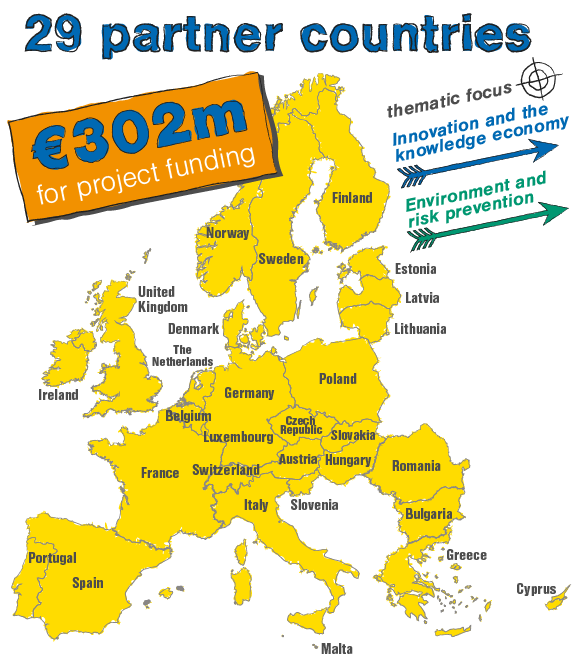
INTERREG IVC was in line with the European Cohesion Policy 2007-2013, aimed
at encouraging overall economic development and reducing differences between
regions in terms of wealth, income and opportunities.
In order to channel efforts for the best results, the programme focused on
improving regional and local policies in two areas:
- Innovation and the knowledge
economy
- Environment and risk
prevention
Supporting initiatives in these areas linked the programme to two other
objectives of the European Union: the Lisbon agenda (to make Europe the most
competitive economy in the world and achieve full employment) and the
Gothenburg agenda (to adopt a more sustainable pattern of development,
combining economic growth with protection of the environment).
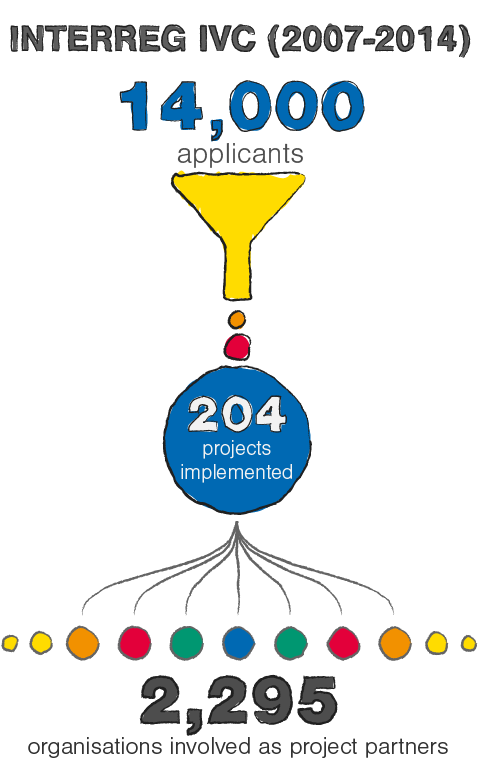
INTERREG IVC encouraged more and less experienced partners to work together and thus help spread knowledge throughout Europe. In this way, regions did not have to reinvent the wheel but could benefit from the knowledge of others and use it to improve policies.
http://micropol-interreg.eu

Click on the map to see the institutions involved in the project.
 Lead partner
 Project partner
A smarter way to work
Many rural regions in Europe are experiencing challenges, as their young and well-educated inhabitants move from the country to the city to find good jobs. At the same time, developments in technology are enabling people to work wherever they want, whenever they want.
Micropol combined these two trends and focused on encouraging distance working to re-vitalise rural Europe. In order to achieve this, the partnership between the 11 regions involved in the project focused on improving policies that support a new working model: Smart Work Centres (SWCs) in non-metropolitan areas. Partners attended a series of thematic seminars and undertook study visits to successful SWCs to help them improve knowledge, skills and strategies for the use of SWCs in rural development and employment policies. They also participated in a survey and exchanged good practices in many other ways.
A hub for newcomers and locals
Micropol showed that SWCs developed throughout Europe take on
a variety of forms to suit local needs. Their main
focus is to provide a flexible base for knowledge-based workers and
businesses, encouraging cooperation and providing technological
(high-speed internet) and administrative support.
In addition to economic benefits such as job creation and increased
productivity, the SWCs contribute to inbound migration and to
sustaining public services. And by reducing commuting distances,
they also have a positive impact on the environment. Moreover, all
positive effects are achieved in a highly cost-effective way: every
euro invested in a rural SWC generates returns exceeding the
investment costs.
Cold Hawaii
The tiny Danish village of Klitmoeller in the North Denmark Region
offers a good example of how Micropol helped to encourage newcomers to
move to a rural region. The former fishing village was
rapidly losing inhabitants to larger cities when surfers discovered
the potential of the location in the 1980s, dubbing it ‘Cold
Hawaii’. Initially, surfers clashed with the local community.
However, when the local surfclub came up with plans to use surfing
to promote tourism and attract newcomers, all inhabitants realised
the potential and joined forces to make the plan a success. The SWC
helped surfing tourists to keep in touch with work (and extend their
stay), supported distance working for surfing newcomers (assisting
their move to Klitmoeller) and provided locals with high-tech
services.
The village currently attracts 1.1 million tourists each year – much
more than the rest of the region – and 160 of the current 800
inhabitants are indeed newcomers.

Could Smart Work Centres increase economic growth and settlement in rural areas or are we just moving jobs from one place to another? “In North Denmark Region we didn’t have the answer to this question back in 2011, which is why we began to look at European cooperation – which experiences could be found elsewhere, who could we learn from? And there turned out to be numerous experiences, with complex, innovative and sometimes unusual solutions, but all of them trying to solve the same challenge of helping rural Europe’s economy and society move into the digital age.”
Jane Ribergaard Holm – Micropol Project Manager, North Denmark Region (lead partner)