INTERREG IVC distributed funds from 2007 to 2013. A total of
204 projects were funded, involving 2,295
partners from all 29 partner countries. INTERREG IVC
projects ran until end of 2014.
Italy contributed the highest number of project partners
(261), closely followed by Spain (222) and
United Kingdom (160).
Nearly all projects included a mix of partners from convergence
regions (regions with a GDP per capita of less than 75% of the EU
average) and competitiveness and employment regions (regions with a
GDP per capita above 75% of the EU average).
Every country had something to gain from cooperation.
 Environment project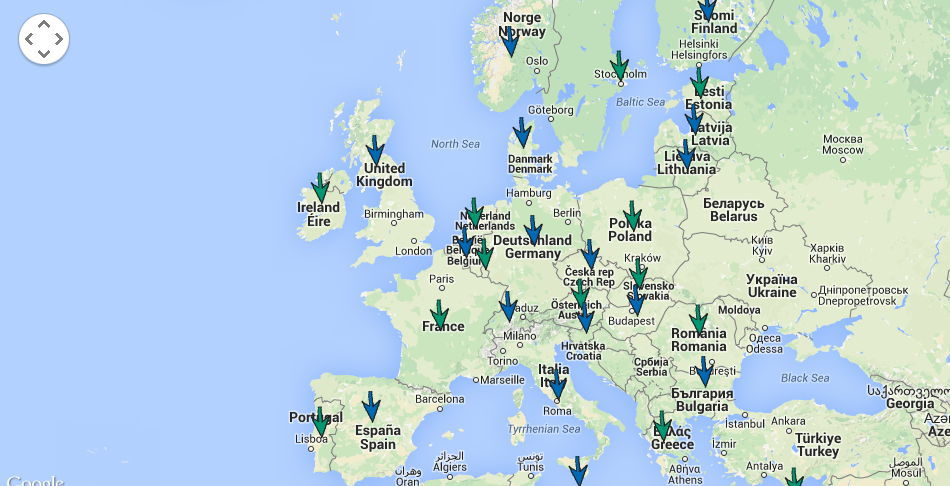
http://www.seeplatform.eu

 Lead partner
 Project partner
Joining forces to create impact
How do you integrate design into innovation policies and innovation programmes? This was the question that the SEE project partners sought to answer. Each of the partners had come to the conclusion that together they could achieve better and bigger results than alone. That is the reason why they decided to join forces in the SEE project.
Bridging the gap between technology and end-user
During the project, the partners organised meetings and thematic workshops to exchange knowledge and transfer good practices. Gradually, their impact on local innovation policy began to grow as design partners connected with technological innovation partners.
A good example of this is the Bike Off 2 project, which applied design processes to cycling-related objects and scenarios in order to reduce bicycle theft. The project created a multi-stakeholder and multidisciplinary network (including academics, police officers, local government officials, transport planners, designers, engineers and criminologists) in order to benchmark up-to-date design standards for securing bicycle parking, test parking facilities and disseminate cycling-related research.
Together, the SEE project partners delivered a convincing message to governmental bodies: design can indeed bridge the gap between technological innovation and end-users and therefore help to drive innovation.
Gaining momentum
The SEE project gained so much momentum that project partners decided to continue their activities after the INTERREG IVC project was completed. They set up the SEE platform.
From 2012 to 2015 the platform operated as part of the European Commission’s European Design Innovation Initiative, to encourage design-driven innovation. The SEE platform is currently co-funded by the Welsh government.
As a result of the efforts of SEE project partners and the European Commission, there has been a marked increase in the number of countries and regions with design included in innovation policies: Estonia launched a programme in 2012 and Denmark and Finland have since followed suit.

“INTERREG IVC enabled us to create a peer-learning platform to exchange experiences between design stakeholders and regional and national governments. This gave us the ability to directly influence innovation policies and programmes as well as to forecast future trends.”
Anna Whicher – Head of Policy, PDR, Cardiff Metropolitan University, United Kingdom (lead partner)