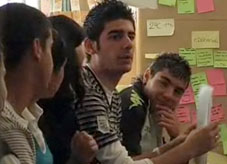
 Doc Next Network initiated a training course “Working with Immigrant Media-makers” in London, taking place on September 12, 13 and 14. The goal of this cross-sectorial training is to develop shared methodologies to involve young D-I-Y creative media-makers with (im)migrant backgrounds in the creation of new remixed media works. The training is part of the ‘Remapping Europe – A Remix’ project.
‘Remapping Europe – a Remix’ is an investigative artistic project that aims to contribute to an inclusive cultural practice and public imagery in and of Europe by connecting young creative media-makers who have (im)migrant perspectives from Spain, Poland, Turkey, and the UK to wider European intergenerational audiences.
The project’s activities stem from one underlying principle: re-mixing of media as a method to re- view, re-investigate and re-consider prevailing imagery of (im)migrants in European societies and to ultimately, ‘re-map’ Europe visually, geographically and mentally.

The activities include transnational, cross-sectorial learning platforms, investigating the immigrant’s perspective in the public debate and imagery; creative remix ateliers in Spain, Poland, Turkey, and the UK, involving 48 young digital storytellers with (im)migrant backgrounds and perspectives; international showcases of their remix works at significant cultural festivals in each of these countries and in an on- line media collection; major remix-performance and installation in Amsterdam and Seville, with a wider participatory, digital component involving European citizens across the continent and a research publication and catalogue documenting the processes and outcomes of the project.
The Goal of this cross-sectorial training is to develop shared methodologies to involve young DIY creative media-makers with (im)migrant backgrounds in the creation of new remixed media works. Cultural experts of the partner organisations (The Doc Next Network ‘hubs’) will bring a community worker of a local immigrant organisation from their country to present and discuss practices on how to reach and include young immigrants in their creative media making ateliers.
What are the challenges and opportunities that can be used for a shared methodology to reach ‘hard-to- get’ target groups? The training is a stepping stone for the inclusion of young immigrants in the remix ateliers.
- To develop a ‘target group’ to understand who it is we aim to work w
 ith;
ith; - To develop a recruitment methodology for finding participants;
- To understand existing methods of practice when working with young (im)migrants;
- To gain an understanding of the tools at our disposal for the Remix Ateliers;
- To develop local and joint Remix Atelier methodologies;
- To create a common language with mutual understandings and agreements;
- To understand how we can avoid stereotyping and pre-assumptions that may hinder the project.
Keep posted about this project , the outcomes of the London training and more Remapping Europe: Like us on Facebook or become a member of our Linkedin group.
 Follow