“I live in Galicia, one of the most aged regions in Europe. Also one of the most pauperised, until recently.
“Galicians have been quite a few centuries knowing what scarcity is. In the nineteenth century, we were responsible for some of the most important migration movements in Southern Europe. Together with Italians and Polish, we went to Argentina, Cuba, Brazil, and México, Venezuela… Most of my neighbours have relatives over there.
“Halfway through the twentieth century, with half of the Spanish population defeated in the civil war and under Franco’s regime, we were still very poor and we left to Switzerland, France, Germany, or United Kingdom looking for work. We were cheap and skilled workforce that did not cause problems. Franco’s repression taught us extremely well not to.
 “Our history is one of migration. Our great-grandfathers and our fathers went abroad to make a living. Now, many of us have to do it too. Along the way, we have also received people from other countries. And we still do, because, even now, there are still many places with less opportunities and where life is worst that in Galicia. However, this is a land of transit. Very few stay here a long time, unless they have been here forever. We are land of sailors, we have sailed one thousand oceans, with one-way tickets, with return tickets. We know what the epic of the journey is, we admire the Odysseus stories of those who leave and, deep down, we envy their adventurous spirit, although we do it in pain. Because if they all leave, even against their will… Who looks after those who stay?
“The Doc Next videos have suggested me a dialectical journey between here and there, between leaving and staying. Both edges, both faces of the precarious life the circumstances force us to live, the political and economic power, the social context… or perhaps just the place we happened to be born in.
“All that changes throughout History. The places change, the people, the maps, our homes, our itineraries and also the eyes through which we look at all that change, the mental image we create of the world we do not inhabit. Even if we have never been there. That is what postcards are for, and they also have two faces: on one, the places we do not know, or that we do not recognise any more, because they have changed. While the relationships with the people we love and are gone travel on the other face.”
Souvenir de… (Istanbul): “It could be that those two edges of migrant life have to do with the two faces of capitalism, the productive and the reproductive parts. Someone had to migrate to make a living, and someone else had to stay to look after the family, the house, the few shared things. Those roles were rarely chosen. And the feeling of desertion affects everyone, those who leave and those who stay. However, when the migrants arrive somewhere, the perspective is future and progress -this does not mean it is not precarious too, quite the opposite-. Wherever they stay, their past and their lives left behind stay with them.”
https://vimeo.com/66056295
The Lights of Flushing (Cornwall): “In this town of Cornwall, those who stay are few and old, and live on memories from the past, because the future is like something that happens somewhere else. Share their traditions, work together to preserve the very little remaining -like hanging the Christmas lights-, are usually good enough reasons to stay. The essence of a sufficiently good life. It may sound conservative, I agree, but it is that spirit that keeps alive many small territories in this era that revolves around big cities and the countries where there are industry or money.”
Self Portrait. Migration’s Biographies (Granada): “Ariana is one of those who stay. For now. She explains how her life has been stricken by other lives of people who left, who stayed, who came back. And she lets us see how, beyond an individual decision, migrations affect everyone around our multiple communities: those who travel, those who stay, those who welcome and shelter…”
Ebb and Tide (Istanbul): “This video is about a Turkish family but it could have perfectly been a Galician one. A self-portrait of the migration to central Europe in the 70’s from its periphery. Memories of a better life were recorded in Super 8, and also the stories of success to tell those who stayed home how the emigrants were doing. Of course, only the nice part was told.”
Viet (Warsaw): “A daughter asks her father to be told the story of his migration from Vietnam to Poland. To be child of migrants must be an interesting way of being in the world. You inherit a homeland, an origin that it is not yours but that adds up to the place you live in. But, specially, you inherit all the feelings that journey carries. Curiosity, denial, memories, homesickness, uprooting… the will to be part of what others had left behind.”
“I am a daughter of those who stayed. In a way, because they also migrated, exactly 33 km, from the town to the city. Years later, I also migrated, exactly 100 km, from the small capital city of a province to the Galician capital, which is not bigger but indeed younger and more dynamic, for being university city. Nothing compared with long migrations, but the feeling of abandonment remains when we go to the empty house of my late grandparents, or when I leave my folks behind on Sunday afternoon, as I go back home after lunch.
 “I am interested in the issue of the feeling of abandonment as it is not just a personal matter. A good share of Europeans live with it in a collective way. And specially in Southern Europe, where we witness a very strong process of dispossession, the lack of jobs and the subsequent migration are leaving us helpless, weak, ready to be colonised by any external “investor” who comes with money to pull us out of the misery, in exchange for pillaging the very little we have left, from our savings to our territory.
“I am a daughter of the aged and precarious Galicia. I was born when my parents were already old, and now I feel very close to their way of becoming elders. Without the touching and condescending distance of the granddaughter, what I could have been considering the age difference. With the proximity and mutual demand for affection of a daughter, with the compromise of care and sharing the fear to future and loneliness. As I grow older with them, I value more and more what they have given me: shared memories and education, the beginning of it all. I like this video very much, Murciegalo, because it talks about the fear to the unknown and the common learning that help us face it, which we learn at home (or not).”
Murciégalo (Sevilla): “They are the ones who have taught us the most in this sense, our mothers and grandmothers. Their ability to battle, their resistance (sometimes mistaken for resignation, I agree), everything they have had to bring forward in the reproductive and productive areas make them super heroines to my eyes. I have found it hard to acknowledge all that effort on my mother, for example, but she now is a source of inspiration to me.
“Even though, that of our grandmothers is the Irrelevant History of Europe. History with small letters, that one they never told us, especially not from their point of view. That is why it is so valuable. And again, education. That one you do not learn at school.”
Una abuela andaluza (Sevilla): “I see my mother, Josefa, in this other mother, Carmen. Although Carmen, in her life, has had and still has much more guts. Carmen is the resistance that, here, it is not mistaken for resignation. The daily battle. The simple life many mothers and grandmothers live, carrying scarcity with much dignity and helping other women to recover that dignity. Carmen’s life is one out of the ordinary. And knowing how to sew is very important.”
Llegando a todo (Sevilla): “If we do stay, we have no choice but to join forces, even though we might not share any previous affective bond. Learning how to live in community with other people who have been left alone is another way of migration.”
Včeraj = jutri (Ljubljana): “In the end, we all live similar stories in both sides of the journey. Shared memory brings us together and we build common stories with it in their infinite versions, which help us understand the mystery of life. Like Refika’s mystery, the woman in the old picture who travelled between a village in Greece and another in Turkey leaving their residents confused about who she was.”
Refika (Istanbul): “So, maps are rearranged, stories are reworded and we no more know very well neither the origin nor the destination of this Europe we happened to live in. Neither we know where actually is the epic of the journey. Although it might not matter much. We share our memory with many people who are far away and that hurts. But our lives are also full of things to share with new people, the ones who came to where we live or those we found where we went. Because that is what is all about, living together and having communities to use as shelter for this precarious life. In Lugo, in Warsaw, in Istanbul, in Flushing or in Seville. Here or there. We never know.”
Read more about Maria…

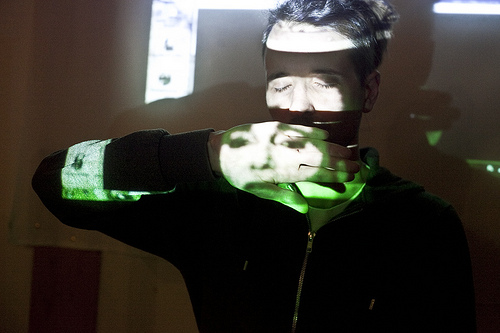
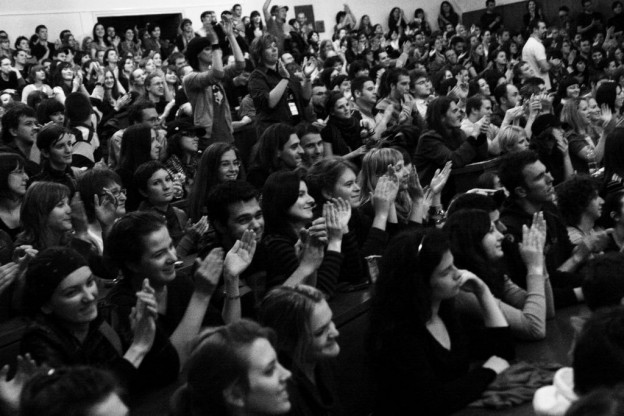
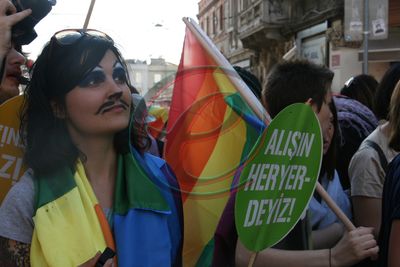
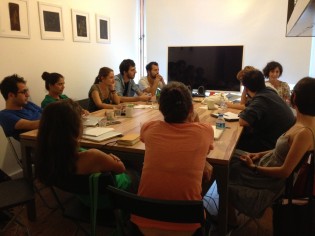
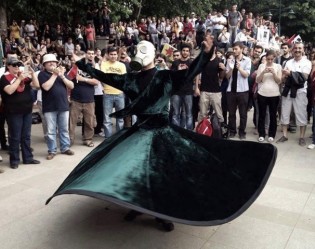 Creative resistance, online and offline, was at the core of the recent Gezi Protests in Turkey and fueled the ‘Gezi Spirit’: People of different social/cultural backgrounds used different outlets to spread the news and to share their voices, while the mainstream media kept its silence. The Gezi (Media) Lab was launched by Doc Next partner MODE Istanbul at the onset of the protests to provide a space for young people to explore the Gezi Spirit and to produce new media works, individually and collectively. Each mini lab, held once a month, includes talks & discussions with guest speakers, hands-on workshops, visits to and screenings at park forums, and focuses on different themes such as “The Symbols of Gezi”, “Video Activism”, “Gender and Resistance”, “The Sound of Gezi”, “The Right to the City and Migration”.
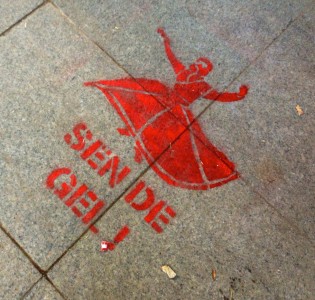 The labbers seek to create links between the widely discussed subjects the Gezi events brought to the forefront like citizens rights, censorship, urban transformation, the reclaiming of public spaces, collective action, commons and migration, and express via their media works their views.