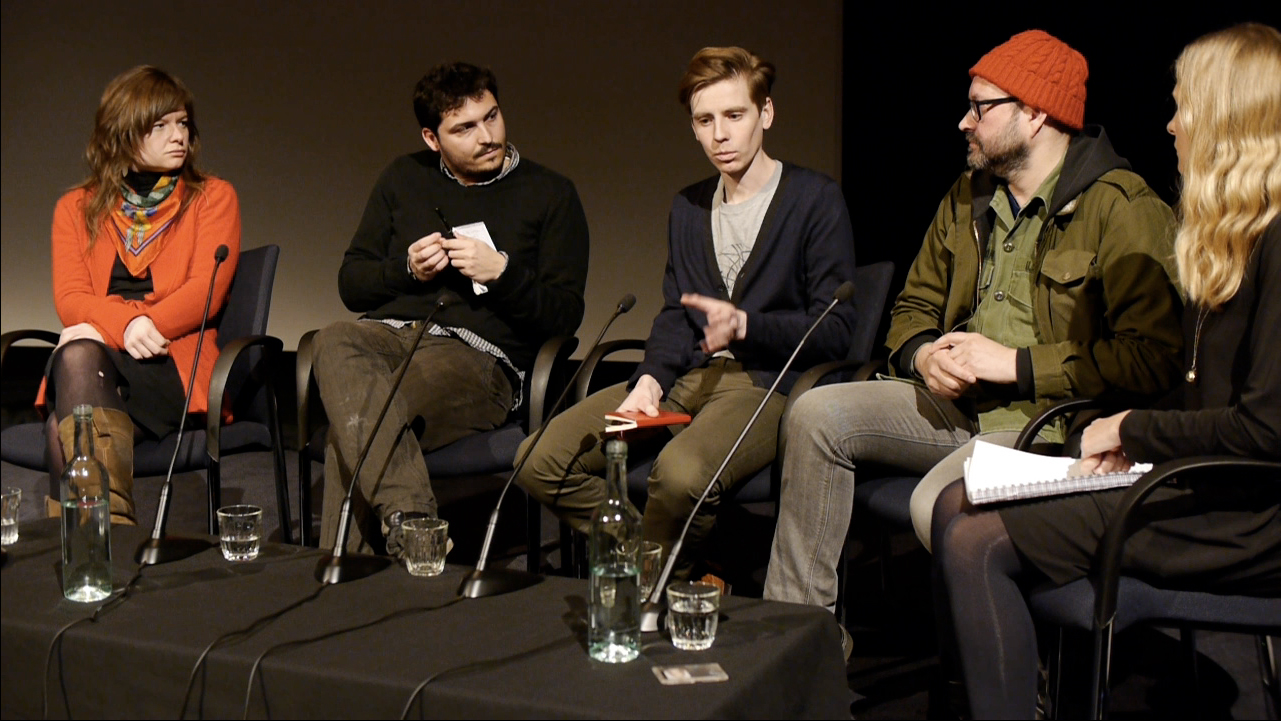
European Souvenirs: Workshop meeting Point

Prelude for European Souvenirs. European Souvenirs is a major live-cinema performance that will be staged for the first time in October 2012 in de Balie (Amsterdam) and will tour afterwards in different countries across Europe and beyond.

Commissioned by the European Cultural Foundation in its quest for new European inspiring narratives, ZEMOS98 (Spain) has designed with its partners in the Doc Next Network an independant, process-oriented, investigative, collaborative, innovative and high quality multi-media project that will shake up our minds and our prevailing imagery of the places we live in.

For more information: http://www.europeansouvenirs.eu/

ZEMOS98 Festival: Copylove

From 11 to 15, April, the 14th edition of ZEMOS98 Festival will be celebrated in Seville. This year’s leitmotif is COPYLOVE which seeks to bring the focus on those communities where the economy of care, reciprocity and trust are essential elements for the management of the commons. The 14th annual ZEMOS98 Festival titles “Copylove: Commons, Love and Remix” has been built collectively through some encounters in which different cultural agents discussed ideas about place of the commons and love within the community, a place in which to deepen, crystallize and put into action the close relationship of both terms. This has created a local team composed of different communities and diverse people with whom to define and articulate the concept of COPYLOVE.

“COPYLOVE: commons, love and remix” is intended to be an open and collective journey in which to propose reflections on the role of taking affects and management of common resources within communities.

All the programme is available in Spanish here.

Some activities will be available online via streaming.

Why we do it?

The key of our thinking about modern media education is parallel activity for the professionalisation of cultural workers and investing in young artists who can combine their artistic potential with social mission, who can share their skills with younger generations. Film and photography are currently two of the most popular media used by young people to learn and describe the world. Cell phones are used as photographic cameras, and cameras provide video and voice recording functions. The recorded images can be published right away on Vimeo, YouTube or on social networking platforms and thus shared with millions of viewers.

Every year organisations, community centres and common rooms invite us to conduct workshops. Each of our film and photography projects has several hundred applications a year. The application and evaluation forms show us that young people need and look for modern media education. In the 9 years of our work we have observed that this kind of education is created and realised by community centres, common rooms, libraries or independent artists and animators. At the same time our experience shows that Poland still lacks animators and educators who consciously work with film and photography.

That is why we have created the Polska.doc programme in which young DIY artists get the opportunity to develop their skills trained by professionals. They go through the project process (form the idea to the finished project) and realise their own (often their first) documentary projects (film, photocasts, photographic series) with the support of experienced tutors. The first year of the programme gave us 13 finished productions. All are accessible on our website (www.polska.doc.e.org.pl). They can also be seen during shows and events initiated by the international Doc Next Network in which we partner.

Within Polska.doc we have also conducted a very important educational path called „Animate on your own!”. Our participants could not only master their talent and make their imagination roam freely but also try to work as a cultural animator. With theoretical and practical knowledge they went to places all around Poland to voluntarily assist experienced tutors and co-conduct multimedia workshops for less experienced friends. Good practices gathered throughout the project are presented on our website in the Inspiration section.

We believe that visual media prove useful in unravelling history and the local identity, in engaging young people in actions for the local community or in integrating neighbours. We want the world to be described by grassroots initiatives, by the members of local communities and with the assumption that the artists want to dig into reality, not slide on its surface.

Association “ę”

www.polska.doc.e.org.pl

Beyond remixing the contraries

As a result of the Political Remix Video call that both EMBED and Doc Next Network started last December, the following selection of remixing works will be screened during the next ZEMOS98 Festival (14th April):

- “Glued” by Benoit Detalle (Belgium) – 5’42″
- “Rock the Caucuses” by Smearballs (Canada) – 3’22″
- “Now, Listen!” by Dominik Dušek (Czech Republic) – 3’
- “Subasta II” by Smalouli (Marrocco) – 2’51″
- “The Manufacture Of Consent” by Enrico Argento (Portugal) – 2’22″
- “WakeUpArtists! (Dedicated to Malish)” by SpriteHat (Italy) – 4’
- “Mutantes” by Duplex Corporeition (Spain) – 4’24″
- “A mi tío” by Lacasinegra (Spain) – 1’33″
- “Our Dangerous Demands” by Malaventura (Spain) – 2’
- “Live Free or Die Hard (Project 12, 8/12)” by Diran Lyons (USA) – 1’12″
- “Abra la boca (Open Your Mouth)” by Montserrat Santalla Gasco (Spain) – 3’31″
- “Rap News X: #Occupy2012 (feat. Noam Chomsky & Anonymous)” by Hugo Farrant and Giordano Nanni (Australia) – 7’48″

Apart from this programme, two works produced by ZEMOS98 in the framework of Doc Next Network remix workshops will be premiered the same day:

- “Cuentos ilustrados” by Pablo Domínguez (Spain) – 12’07″

- “Esperanza Umbridge y la Marea Verde” by El Ejército de Dumbledore (Spain)- 2’48″

This Political Remix Video international call has received 124 audiovisual works in a month time. The selection committee has been formed by Felipe G. Gil and Pedro Jiménez de ZEMOS98, Joan Carles Martorell (Yerblues.net) y Alberto Tognazzi (Movil Film Fest).

This committee highlights the fact that all these works go beyond the simple technique of «remixing the contraries». They (together with Jonathan McIntosh at PoliticalRemixVideo.com) understand political remix videos as an audiovisual genre which puts into practice the «situationist detournement», using the media to criticize power structures, to deconstruct social myths and defy the mass-media via «re-cutting» and «re-framing». This remix is done from media fragments mixed with pop culture. Could this way of understanding audiovisual remix be a new kind of documentary? How are we going to access the collective memory if it’s already remixed? Aren’t the media using remix techniques as a sort of aesthetic of social reality? Let’s carry on researching into this path and learn from our community.

What’s on now?

Zemos98's Ruben Diaz sits on the panel for the Future Film Festival Documentary Awards.

Good afternoon one and all! It’s been a wee while since I last put anything up here, and I blame that completely on the hectic time we’ve been having here at the BFI!

Last month we hosted our 5th BFI Future Film Festival, with workshops, screenings, panel discussions and more! We welcomed Dexter Fletcher and Will Poulter to talk about the new feature Wild Bill, as well as a whole host of talent, ranging from the new BAFTA nominated filmmakers of Black Pond to old hands like and David Westhead, who hosted our Doc Next Pitching masterclass. This masterclass saw 30 young people learn how to sell their documentaries, before 6 finalists from our #FFPitch competition took to the stage to battle it out for a trip to one of our wonderful partners. Congratulations to Jaha Browne for getting that one – her pitch for a doc about England’s only Technology addiction rehab clinic was brilliant!

If you want to read a little more about the festival and our guests, why not check out Pai Takavarasha‘s interviews with Dexter Fletcher, Will Sharpe and Debs Paterson. Alternatively the young people over at Mouth that Roars made a short video documenting their time there – check it out!

We’ll be posting our very own documentary about the festival soon, with filmmakers from IdeasTap, Live Magazine and the Future Film Institute coming together under the direction and organisation of cinematographer Alex Nevill to film our events. More on that soon!

So, what else have we been up to I hear you ask. Noel Goodwin and I (Matthew Cuzner) went up to Glasgow Youth Film Festival just before the Future Film Festival, where we hosted another Pitching competition that saw two talented Glaswegians join the ranks of young people we’re jetting off to our partners soon!

We’ve also been busy planning away our Doc Next Network celebration day What’s Your Story?, which is tomorrow! (Saturday 17th March). We’re screening a programme of short films we’ve funded through the network, including some new, as yet unseen documentaries by the young people over at Exposure and Screen South. They’ll soon be up on the Vimeo channel, so keep an eye out over the next week.

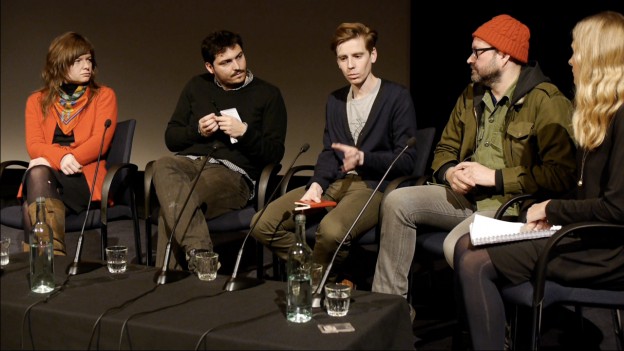
Along with the programme of films, apparently a new Future Film regular, Mawaan Rizwan will be hosting a panel discussion on how to get your documentary made. We’ve got representatives from , Metropolis TV and Channel 4’s Commissioning editor for Battlefront! They’re going to be dishing out advice on the whole process, from finding an idea to distribution, so come on down!

Anything else? Well yes. We’ve also been down to IdeasTap, again with Dexter Fletcher and Will Poulter for another screening of Wild Bill. And we’ve been sourcing new Docs for the media collection – there’s a whole load in the cyber-post coming over to us, which will be up soon. And we’ve been planning our event on the 31st March for the London Lesbian and Gay Film Festival (Featuring a bunch of great short films, a panel discussion on the representation of LGBT characters on film and our wonderful LLGFF Young Reporters Academy. And we’ve been… well, you get the drift. We’ve been busy.
More than four hours a day on the internet

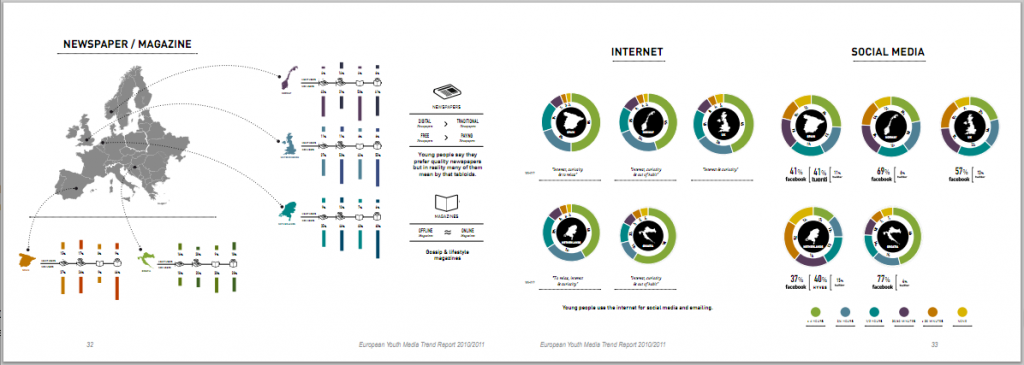
Young people are attached to their mobile phones… But do they still use landlines? Is online television as popular as ‘regular’ television? What is the most popular games console among today’s young people across Europe? And what are the biggest differences between European countries in terms of how they use media today?

The answers to these questions – and more – can be found in the first European-wide Youth Media Trend Report (2011-2011), which was commissioned by the Youth & Media Programme of the European Cultural Foundation (ECF).

The extensive research was carried out by the Belgian research centre Trendwolves, which looked at media use among young people aged between 15 and 25 in five European countries: Norway, the Netherlands, Spain, the United Kingdom and Croatia.

Researchers mapped how young people use media in each of these five countries, focusing specifically on social networks, internet, telephone, television, radio, newspapers, magazines and games.

The first Youth Media Trend Report of its kind identifies different media landscapes across Europe and represents an important step in measuring, observing and revealing changes in the way young people use their media.

Page from: European-wide Youth Media Trend Report (2011-2011)

With this research, ECF aims to provide broad access to exclusive data to cultural, political and media organisations and professionals working on youth and media policies and programmes. The research is designed to fill a gap for the cultural sector, which is often deprived from mere facts and figures, unlike the business sector, in which such research data are used for designing successful marketing strategies and forecasting trends.

Interested in finding out more? Download the report in infographics here.

For inquiries on how to access the full report, please contact mweijs@eurocult.org

Doc Next examines copylaw alternatives

On 21 and 22 February, Doc Next Network attended a workshop on intellectual property related to media and culture. This two-day workshop in London gave a comprehensive view of copyright law, so that we are able to understand why copyright exists and how it works.

Central issue how can copyright law serve the purposes, goals and needs of the participants and the Doc Next media collection.

Given the existing legal framework, we analysed the law to see what licences would be the best fit for our media collection. We focused on open licences like Creative Commons, to see why they were created and how they work. As a conclusion and practical outcome the workshop ended proposing, with the contribution of all the participants, we chose the legal tool that can best serve our goals.

During the workshop we encountered a void within the legal system considering copylaw: no legal tool fits so-called mashups or other derivative works. Workshop moderators Eva Sòria (historian) and Abel Garriga (attorney) took the challenge and will stay involved in Doc Next Networks quest for an alternative copyright / -left.