
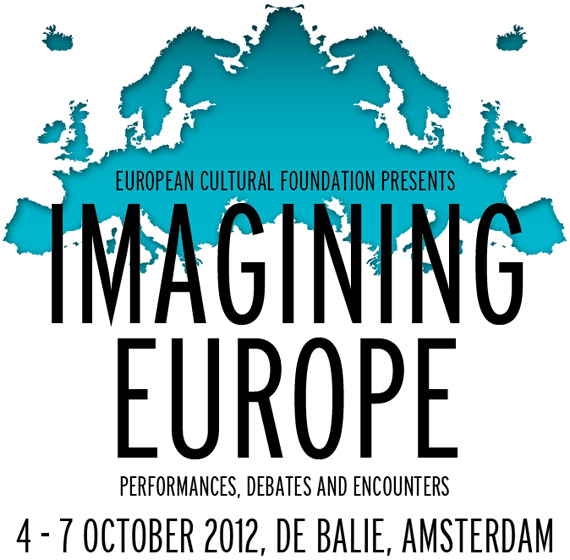
 Between the dates of October 4-7, 2012, the European Cultural Foundation (ECF) presented Imagining Europe at the renowned cultural space De Balie in Amsterdam. Live performances, debates and encounters to imagine a new Europe were held during the four-day event.
De Balie in Amsterdam hosted a series of activities under the title Imagining Europe, presented by the ECF, between the dates of October 4-7, 2012. During the events, talks and discussions, participants tried to find out what the contemporary problems in our societies are, and imagined the future of Europe; artists from different countries and backgrounds displayed their live performances. One of the most memorable events was the live cinema performance of European Souvenirs, a Doc Next Network project commissioned by the ECF, curated and designed by Zemos98 (Seville) in collaboration with other Doc Next partners, the British Film Institute-Future Film (London), the Association of the Creative Initiatives “ę” (Warsaw) and MODE Istanbul (Istanbul). All the artists and participants of Imaging Europe tried to find an answer to the question of how to re-imagine and re-map a new Europe.
October 4 – Imagining Europe started with the opening speech of the ECF’s President Princess Laurentien of the Netherlands at De Balie. After the Princess’s speech, Dutch TV presenter Twan Huys introduced internationally known Bengali Indian author, Amitav Ghosh to the audience. Ghohs talked about world economy and politics, and the crisis of climate change during his speech. He gave comparative examples from different regions of the world and the different periods in history, and focused on the problem of growth and consumerism. After the dinner, renowned Syrian clarinetist player and composer Kinan Azmeh and Dutch trumpet player Eric Vloeimans shared the same stage for their exclusive live performance.
October 5 – The second day of Imagining Europe continued with the debate “Reclaiming the Public Space” at De Balie. As the opening speech, British curator and writer Charles Esche came to the stage and talked about the role of art in Europe’s and the world’s shared future, and the question of reinventing democracy. Then, moderator Farid Tabarki, the founder and director of Studio Zeitgeist in Amsterdam, invited Belgian lecturer and poet Peter Vermeersch, British sociologist Tiffany Jenkins and Spanish innovation manager Juan Freire to talk about the role of the artists and cultural actors in creating new channels for a new political imagination. Participants of the debate discussed about the contemporary problems in Europe as well as in the world, and shared the belief that we need to re-imagine and re-develop new organizational approaches.
After the debate on the Europe’s future, the night continued with the world premiere of “a culinary experience”, Trash Cuisine, by Belarus Free Theatre, at Stadsschouwburg of Amsterdam. Belarus Free Theatre, which is formed by a group of artists who were exiled by dictatorial leadership in their home country, performed an exceptional and emotional play underlying the political pressure and violence in Belarus.
October 6 – The third day of Imagining Europe continued with the “Reflection on the Future of Funding Cities” at the Mirror Salon, De Balie. After the debate, European Souvenirs took the stage. The five European media artists Karol Rakowski (Poland), Barış Gürsel (Turkey), Farah Rahman (Netherlands), Malaventura (Spain) and Noriko Okaku (United Kingdom / Japan) presented an experimental live cinema performance, which is created by remixing materials gathered through extensive research on media archives. While European Souvenirs artists questioned Europe and the world, they showed how borders are crossing (shifting) by reminding the viewers the universal concepts such as family, travel, borders and memoirs.
October 7 – On its fourth day, Imagining Europe ended with a film screening and conversation with the film director and cultural activist John Akomfrah.
 Follow