Category Archives: Research & Debate

ZEMOS98 Festival: Copylove

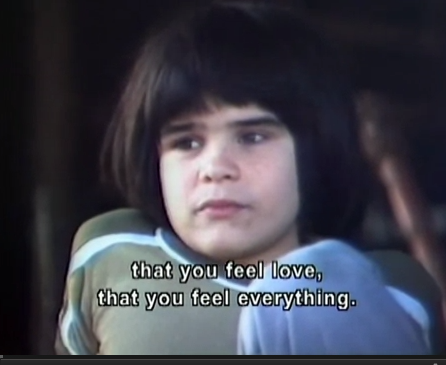
From 11 to 15, April, the 14th edition of ZEMOS98 Festival will be celebrated in Seville. This year’s leitmotif is COPYLOVE which seeks to bring the focus on those communities where the economy of care, reciprocity and trust are essential elements for the management of the commons. The 14th annual ZEMOS98 Festival titles “Copylove: Commons, Love and Remix” has been built collectively through some encounters in which different cultural agents discussed ideas about place of the commons and love within the community, a place in which to deepen, crystallize and put into action the close relationship of both terms. This has created a local team composed of different communities and diverse people with whom to define and articulate the concept of COPYLOVE.

“COPYLOVE: commons, love and remix” is intended to be an open and collective journey in which to propose reflections on the role of taking affects and management of common resources within communities.

All the programme is available in Spanish here.

Some activities will be available online via streaming.

Why we do it?

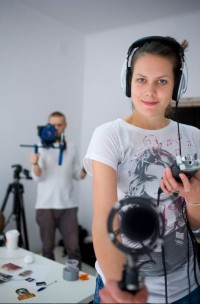
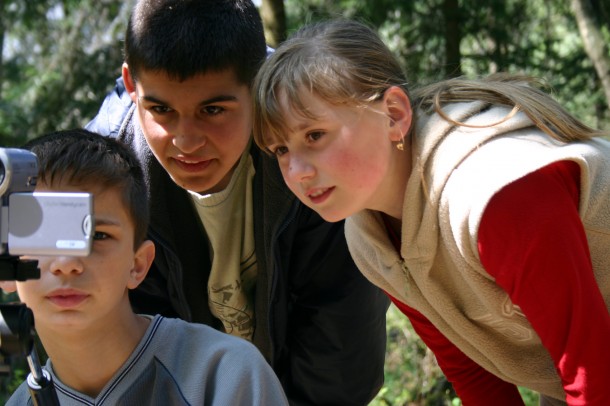
The key of our thinking about modern media education is parallel activity for the professionalisation of cultural workers and investing in young artists who can combine their artistic potential with social mission, who can share their skills with younger generations. Film and photography are currently two of the most popular media used by young people to learn and describe the world. Cell phones are used as photographic cameras, and cameras provide video and voice recording functions. The recorded images can be published right away on Vimeo, YouTube or on social networking platforms and thus shared with millions of viewers.

Every year organisations, community centres and common rooms invite us to conduct workshops. Each of our film and photography projects has several hundred applications a year. The application and evaluation forms show us that young people need and look for modern media education. In the 9 years of our work we have observed that this kind of education is created and realised by community centres, common rooms, libraries or independent artists and animators. At the same time our experience shows that Poland still lacks animators and educators who consciously work with film and photography.

That is why we have created the Polska.doc programme in which young DIY artists get the opportunity to develop their skills trained by professionals. They go through the project process (form the idea to the finished project) and realise their own (often their first) documentary projects (film, photocasts, photographic series) with the support of experienced tutors. The first year of the programme gave us 13 finished productions. All are accessible on our website (www.polska.doc.e.org.pl). They can also be seen during shows and events initiated by the international Doc Next Network in which we partner.

Within Polska.doc we have also conducted a very important educational path called „Animate on your own!”. Our participants could not only master their talent and make their imagination roam freely but also try to work as a cultural animator. With theoretical and practical knowledge they went to places all around Poland to voluntarily assist experienced tutors and co-conduct multimedia workshops for less experienced friends. Good practices gathered throughout the project are presented on our website in the Inspiration section.

We believe that visual media prove useful in unravelling history and the local identity, in engaging young people in actions for the local community or in integrating neighbours. We want the world to be described by grassroots initiatives, by the members of local communities and with the assumption that the artists want to dig into reality, not slide on its surface.

Association “ę”

www.polska.doc.e.org.pl

More than four hours a day on the internet

Young people are attached to their mobile phones… But do they still use landlines? Is online television as popular as ‘regular’ television? What is the most popular games console among today’s young people across Europe? And what are the biggest differences between European countries in terms of how they use media today?

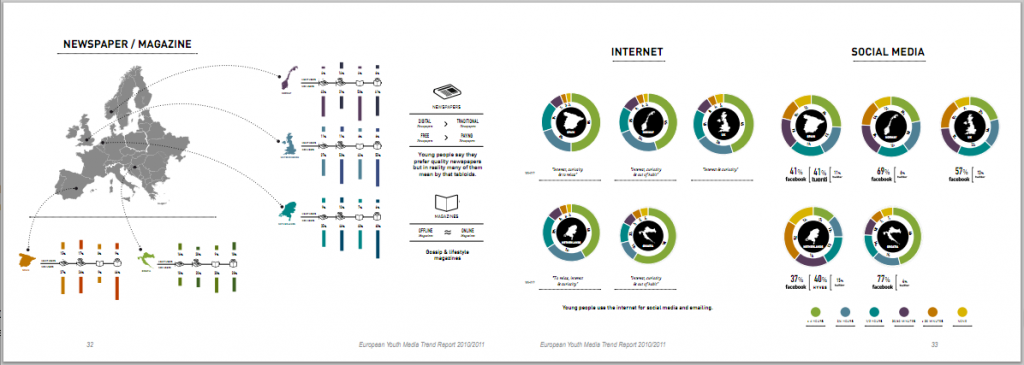
The answers to these questions – and more – can be found in the first European-wide Youth Media Trend Report (2011-2011), which was commissioned by the Youth & Media Programme of the European Cultural Foundation (ECF).

The extensive research was carried out by the Belgian research centre Trendwolves, which looked at media use among young people aged between 15 and 25 in five European countries: Norway, the Netherlands, Spain, the United Kingdom and Croatia.

Researchers mapped how young people use media in each of these five countries, focusing specifically on social networks, internet, telephone, television, radio, newspapers, magazines and games.

The first Youth Media Trend Report of its kind identifies different media landscapes across Europe and represents an important step in measuring, observing and revealing changes in the way young people use their media.

Page from: European-wide Youth Media Trend Report (2011-2011)

With this research, ECF aims to provide broad access to exclusive data to cultural, political and media organisations and professionals working on youth and media policies and programmes. The research is designed to fill a gap for the cultural sector, which is often deprived from mere facts and figures, unlike the business sector, in which such research data are used for designing successful marketing strategies and forecasting trends.

Interested in finding out more? Download the report in infographics here.

For inquiries on how to access the full report, please contact mweijs@eurocult.org

Doc Next examines copylaw alternatives

On 21 and 22 February, Doc Next Network attended a workshop on intellectual property related to media and culture. This two-day workshop in London gave a comprehensive view of copyright law, so that we are able to understand why copyright exists and how it works.

Central issue how can copyright law serve the purposes, goals and needs of the participants and the Doc Next media collection.

Given the existing legal framework, we analysed the law to see what licences would be the best fit for our media collection. We focused on open licences like Creative Commons, to see why they were created and how they work. As a conclusion and practical outcome the workshop ended proposing, with the contribution of all the participants, we chose the legal tool that can best serve our goals.

During the workshop we encountered a void within the legal system considering copylaw: no legal tool fits so-called mashups or other derivative works. Workshop moderators Eva Sòria (historian) and Abel Garriga (attorney) took the challenge and will stay involved in Doc Next Networks quest for an alternative copyright / -left.


A new workshop: HTML5 and open video possibilities


0. What

“Posibilidades del Open Video y el HTML5” (HTML5 and Open Video possibilities) is a research, educational and work-in-progress project that will be developed using Open Video and the new HTML5 standard.

The main goal of this project is to develop an interactive audiovisual tool for the internet. Contents and developments resulting from the project will be open and free (in the sense of free software).

1. How

This project will make possible to mix and remix video, audio, photos and links using the internet. This project will be a part of the Audiovisual Source Code methodology, so it will develop audiovisual mixtapes from online audiovisual sources. Everything will be online.

2. When

The project has three phases

PHASE 1: Workshop on HTML5 and Open Video, by A Navalla Suiza
12th-14th December 2011 @Sevilla

Contents

  • Introduction to HTML5
  • Open Video possibilities
  • Audiovisual Examples
  • Popcorn.js or similar development frameworks

The objective is to develop a simple collaborative audiovisual project in HTML5.

Programme:

1. Introduction to HTML5: HTML, CSS, Javascript.

2. Online video and audio: why it is important that video and audio were HTML elements, video/audio formats, browsers, interaction with HTML elements.

A. Practice: show a video in a HTML document, check the code and features.

3. Use of javascript to develop video/audio events

B. Practice: Using the native javascript API

4. Frameworks and tools to develop video/audio on the net

5. Use of popcorn.js, $media and audio APIs

C: Practice: Design a collaborative project


PHASE 2: Intensive development of the tool

15th-17th December 2011 @Sevilla


PHASE 3: Presentation of the tool with info/documentation of the development process.

April 2012 @Festival UBICUA 2012 (Sevilla)

Who

A navalla suíza is an Internet communication company focused on web development services, social networks and video-based websites. We also develop digital culture & society contents, in particular those related with digital storytelling and crowdsourcing.

With

An initiative by ZEMOS98 for the Doc Next Network, supported by  the ECF Youth&Media Programme and CICUS LAb “Sueño Digital” (University of Sevilla)
 

It’s the Political Economy, Stupid!

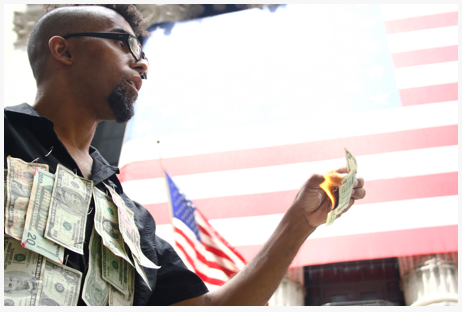
Dread SCOTT, Still from Money to Burn (2010) Courtesy of the artist

This looks like a really interesting exhibition with some provocative ideas – I wish I was in New York for it! Definitely an interesting organisation to watch though…

The Austrian Cultural Forum New York is pleased to present a new group exhibition titled It’s the Political Economy, Stupid. The show, which was curated by the Austrian-American team of Oliver Ressler and Gregory Sholette, derives its name from the slogan which in the early 1990s came to define then presidential candidate Bill Clinton’s campaign, “It’s the economy, stupid”.

The economic crisis that we face today has also become a major crisis for representative democracy. The very idea of the modern nation state is in jeopardy as the deterritorialized flow of finance capital melts down all that was once solid into raw material for market speculation. It is the social order itself, and the very notion of governance with its archaic promise of security and happiness that has become another kind of modern ruin.

It’s the Political Economy, Stupid brings together an international group of artists who focus on the current crisis in a sustained and critical manner. Rather than acquiesce to the current calamity, this exhibition asks if it is not time to push back against the disciplinary dictates of the capitalist logic and, by use of artistic means, launch a rescue of the very notion of the social itself.

The exhibition includes documentarian approaches, such as works by Julia Christensen, who explores the transformation of defunct Big Box stores throughout the U.S. as an example of the resilience and resourcefulness of those affected most by the crisis. A piece by Yevgeniy Fiks, Olga Kopenkina, and Alexandra Lerman, documents those who have the experience of working in the corporate environment, the field of finance, as well as several professors of economics as they participate in a discussion about Vladimir Lenin and his ideas about finance capitalism. Films by Jan Peter Hammer and Melanie Gilligan reflect the artists’ fictionalized takes on the crisis, by drawing historical paralells and showing the microcosmic point of view of those directly involved, respectively.

Quite a few artists and collectives took a performative and decidedly actionistic path, all of which represent artistic precursors to the Occupy Wall Street movement: Performance artist Dread Scott literally burned money on Wall Street, until he was stopped by the police. The flo6x8 group staged flamenco-dancing flashmobs in Spanish banks to protest against the financial system, while Alicia Herrero staged public fora at the National Bank of Argentina, in which experts, artists, and activists discussed theoretical models and ideas for economic and political change. The collective known as the Institute for Wishful Thinking (IWS) tackles the eternal recurrence of the capitalist crisis with a series of site-specific visual commentary on the infamous 1975 New York Daily News headline: “Ford to City: Drop Dead”.

Austrian artist Isa Rosenberger‘s piece, Espiral – A Dance of Death in 6 Scenes, takes a 1930s Weimar-era political ballet, and transposes it to reflect the present-day crisis. Zanny Begg and Oliver Ressler employ the medium of animation to explore how governments in the United States, and other places in Europe such as Ireland, managed to turn a banking crisis into a budgetary crisis.

As a tangible complement to these video works, Austrian artist Linda Bilda was commissioned to produce a wall mural for the exhibition. Her graphic series The Golden World is a point of departure, as it explores themes such as greed and competition in the monetary world.

The opening reception for It’s the Political Economy, Stupid will take place on Monday, January 23, 2012, from 6PM to 8PM. Barbara Prammer, the President of the National Council of Austria, will be present to support and officially open the show. The opening will be preceded by an artist talk featuring participating artists Linda Bilda, Melanie Gilligan, Alicia Herrero, Olga Kopenkina, Alexandra Lerman, Dread Scott, and the curators Oliver Ressler and Gregory Sholette. The talk will take place in the auditorium of the Austrian Cultural Forum from 5PM to 6PM (Free admission. Due to limited seating, rsvp is req’d for the talk. For tickets, please visit acfny.org/event/726).

About the Austrian Cultural Forum New York
With its architectural landmark building in Midtown Manhattan the Austrian Cultural Forum New York is the cultural embassy of Austria in the United States. It hosts more than 200 free events annually and showcases cutting-edge Austrian contemporary art, music, literature, and academic thought in New York. The Austrian Cultural Forum houses around 10,000 volumes in its state-of-the-art library, and enjoys long-standing and flourishing partnerships with many venerable cultural and academic institutions throughout New York and the United States.

Visit acfny.org for more information.

Everything is a remix: the Matrix

Everything Is A Remix: THE MATRIX from robgwilson.com on Vimeo.

Que Neo siga al conejo blanco; o que sea el elegido; que descubra que está viviendo en la caverna de Platón; o que las máquinas terminen dominando al hombre en el desierto de lo real; todas estas han sido razones para ligar The Matrix con referencias culturales conocidas por todos como Alicia en el país de las maravillas, la Biblia, la filosofía platónica o la inteligencia artificial. Razones para entender la cinta de los hermanos Wachowski como un palimpsesto cultural.

A pesar de no proponer nada nuevo (ni siquiera el efecto «bullet time» era la primera vez que se utilizaba y sus autores reconocieron la fuerte influencia que para ellos había tenido Ghost in the Shell), The Matrix se convirtió a finales de la década de los noventa en toda una referencia para la cultura audiovisual.

Ahora Rob Wilson, como ya hizo con Kill Bill (Quentin Tarantino), explora el código fuente audiovisual de The Matrix para descubrir por qué es una referencia de referencias: everything is a remix.

Poland.doc Inspirations available in English

Inspirations is a series of articles, interviews and videos written with young creators and culture animateurs in mind.

The series opens with a documentary series How to make a film, created by Polish documentary maker Piotr Stasik for the public television channel Kultura. Texts range from general reflections on being creative (To be creative by cultural animateur at the Center for Contemporary Art in Warsaw, Maria Parczewska) to practical advice (Photography in work with children by Association “ę”’s own Agnieszka Pajączkowska).

With something to liven up the minds of every one interested in film, photography or more broadly creative work, Inspirations invite the reader to challenge themselves – to be inspired.

Full list of articles and videos is available at the Poland.doc website.

All episodes of How to make a film also available on the Association “ę” Vimeo channel.

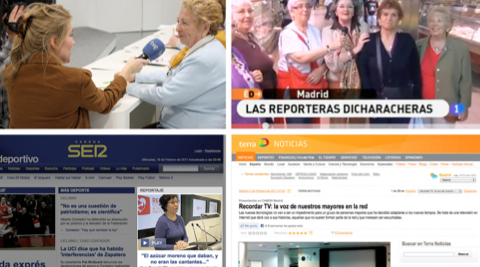
Recordar.TV, listening to our elders

Within DNN media collection, there are 5 categories or themes. One of these categories is the present past, described as «how the past affects the stories and experiences of different generations».
Well, here we have a project that absolutely deal with this topic: Recordar TV (Remember TV).

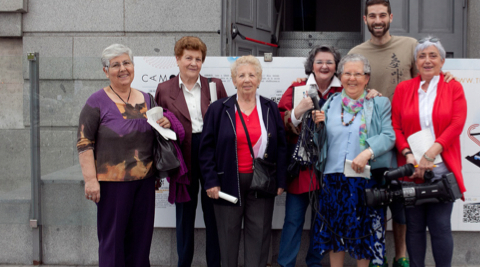
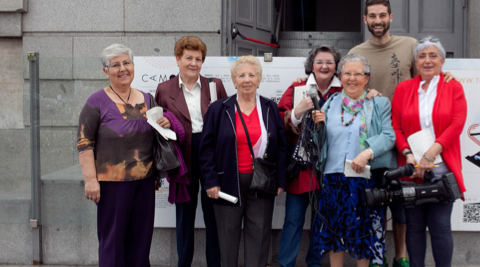
Recordar TV (Remember TV) is an internet television built up from the perspective of the elderly. It aims to encourage digital literacy among this collective, promote their stories, which do not often take part on the net, and also help with the local issues that could be of public interest on the internet. This is an internet television project, therefore we will not only publish videos, we will take advantage as well of the multimedia languages that are possible on the web.

You can find an English version of the project’s dossier here

The elderly of our society have many things to tell us and Recordar TV has a vocation for listening to them. We would like to encourage those stories which are not usually present on the web and look after local worries subject to public interest and also being creative at the same time. And we would like to do it through an internet television. But not just any television on the internet, but one which is made from the perspective of the elderly. For and by them. And, in that way, help out with the digital literacy of this wide social group, which is highly relevant nowadays in the current paradigm in which life expectancy keeps increasing.

The lack of communication of a society with their elders usually is not an issue of age difference, neither it is due to diverse generations not understanding one another. Sometimes it happens that the tools we use to do it are just different. Because growing older not necessarily means stop being young. That is the reason why we want to share the tools that exist nowadays with people that did not have, for whatever reason, the chance to get to know or handle them with ease to make them part of their everyday life.

We are going to explore the lands where languages get mixed up, where prejudices vanish away, where lives cross one another. We are going to play again.

Because it is never too late to learn. And it does not matter how much you know, but how willing you are to keep learning.

We are nominated!!!

Doc Next Network is nominated for the Erasmus EuroMedia Awards 2011!

The Erasmus EuroMedia Award is an annual prize, launched in 1995, to outstanding media productions contributing to the development of a European society. Doc Next has been nominated for its media collection and the entire network that is providing content to this media collection.

The award ceremony will take place on 14 October 2011 in Vienna.  The ceremony is a meeting point for international media professionals. The afternoon presentation of the winners and the festive evening reception provide the ideal ambiences to socialise and exchange ideas. Covered by news media from all over Europe, the EuroMedia Awards attract attention to our work.

The EuroMedia Awards honour media productions that:

  • enhance the media discourse on Europe
  • provide a qualitative discussion of objectives, perspectives and challenges for the development of European Societies
  • relate to European topics like cohesion, social values, migration, identity, solidarity …
  • show an educational ambition
  • invest ideas and ambition in an European Public Sphere