Category Archives: Remapping Europe

‘Remapping Europe – a Remix’ is an investigative artistic project that aims to contribute to an inclusive cultural practice and public imagery in and of Europe by connecting young creative media-makers who have (im)migrant perspectives from Spain, Poland, Turkey, and the UK to wider European intergenerational audiences.

Book European Souvenirs now!

Delving into audiovisual materials from leading European archives, Doc Next Network brings you European Souvenirs that offer a trip down memory lane. Remixing music, photography and film, the European Souvenirs artistic group re-examines the prevailing imagery of immigrants across European communities and re-maps Europe visually, geographically and conceptually.

European Souvenirs is a major live-cinema performance by artists Karol Rakowski (PL), Barış Gürsel (TR), Farah Rahman (NL), Malaventura (ES) and Noriko Okaku (JP/UK).

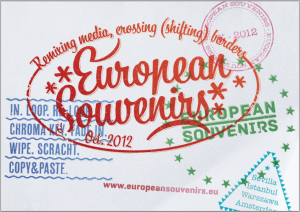
European Souvenirs tours in different countries across Europe and beyond. You can book the show for your own event or venue now! Download the folder including the booking conditions and contact information by clicking on the image on the right.

This video shows 15 minutes of European Souvenirs. The original length of the performance is 50 minutes. More…

Aha! This is Remapping Europe!

We all like stories. We create them. We consume them. We distribute them. And we remix them. Today, I have a little story to tell you about Remapping Europe.

A lot of time, the most interesting things that happen around proffesional and cultural projects are the unexpected and unplanned things. Yes, you usually have a budget, meetings, agendas, dates, workplans, teams, tasks, documents, emails and of course, stressful situations.To be very brief, Remapping Europe is an international project run by  Doc Next Network, to create and share stories to rethink our european identity. We want to work with migrants to ‘re-map’ Europe visually, geographically and mentally. But as you can see (and feel), this is the official definition. And of course, I can tell you a lot of things from this perspectives (because believe me, in the Doc Next Network, we love to open new documents. We are on the very brink of crashing Google Docs). So, this morning, I experienced something that showed me a personal and unofficial definition of what Remapping Europe is.

ahmed

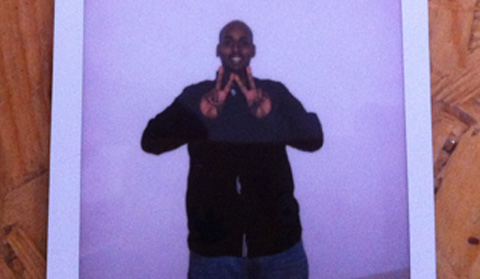
This is Ahmed. He was born in Somalia but he is living in London. His father was very lucky: in Somalia, someone working at the BBC there who could get out people of the country organized a kind of job-offer to get out 3 people from there. There were a lot of people who wanted to leave the country. Ahmed’s father was one of these.

Ahmed studied Filmmaking in London. Now, he is in contact with the Refugee Youth organization, based in London. And now, this organization is collaborating with the British Film Institute (one of the hubs of the Doc Next Network). He will be one of the “Travelling Participants” in Remapping Europe. His responsibility is to travel to every country (Poland, Turkey, Spain) and to be the storyteller of these experiences to the rest of Refugee Youth.

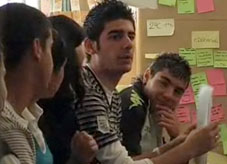
I met him yesterday. It was the first workshop of Remapping Europe in Warsaw. We had to make a game to present ourselves. We were in pairs, and we had 15 minutes to tell our story. Then, we had to present our partner to the others and take a photo of him/her. It was in the moment that Ahmed told us that he has two kids, and in the photo you’re watching he is imitating one of his kids making a “double-sign-of-peace” with his hands.

But it was this morning when I really felt “Ok, this is Remapping Europe”. We were having breakfast. When you are not an anglo-parlant, it’s the worst moment of the day because your english-skills are still sleeping. But then we started a conversation about free culture. And I was myself again, explaining the main core of Free culture, the Creative Commons licences, what the public domain is, etc. And then we connected with the african oral tradition of Ahmed.

And there we were: a Canary guy with French and Andalusian roots (and maybe it’s my intuition, with Phoenician ancestors) talking about free culture with a Somali guy living in London, in the middle of the snow in Warsaw.

I know that maybe it sounds naive, but for me, I realised in this moment that it’s part of my work. But it’s also part of my life. Because we were remapping europe.

By Abrelatas from ZEMOS98

Abrelatas says: Thankx Matt, for helping me with my English!

Re-imagining Europe (on tour).

How do we imagine Europe? How do non-Europeans imagine Europe? What does it mean to be European, indeed? What is Europe really about? How do we imagine ourselves and the otherness? What does it mean to stay together? How are cliches, stereotypes, etc. being built in our societies? What happens when we ask these questions, when we ask ourselves our deepest fears, certainties and assumptions?

European Souvenirs (Crossing Shifting Borders) live cinema and remix performance was staged for the first time on Saturday, 6th October in Amsterdam. The event it was framed in, Imagining Europe, was «questioning what (…) means to be part of Europe and whether (Europeans) want to continue to be part of it, while people around the world are talking about Europe’s economic and cultural future».

[youtube http://www.youtube.com/watch?v=Z9-pAGmo9F4&w=560&h=315]

The combination of live cinema (rooted in the origins of cinema) and remix (sampling from pre-existing footage to combine them into new forms according to personal taste) can truly contribute to deconstruct our social and cultural European imaginaries: all the symbolic dimension in which our values, norms, traditions, identities or borders are represented. Or being more precise: the ways of togetherness we all can imagine. If we can really live together or not is a question the show brings up to the audience again and again.

European Souvenirs is a collective exploration by five young media artists featuring media found at archives in their countries and existing imagery of Europe and its travellers. This expedition is deeply influenced by the hegemonic media landscape we silently consume in our daily life: music videos, commercials, tv news, pop culture ultimately.

However, Europeans (and this project is an investigation about what being European really means) are much more told what they are than telling the stories about what they feel they are. That’s the reason why the show uses home video archives, found footage and audiovisual material from different institutions in Europe, in charge of the common memories.

Karol Rakowski (PL), Barış Gürsel (TR), Farah Rahman (NL), Malaventura (ES) and Noriko Okaku (JP/UK) draw a new picture departing from these images but uncovering the veil of them. what the audience will find during the show is an exploration of new narratives searching for a much more inclusive Europe. images are accompanied by data unveiling, for instance, a map of European colonization.

European Souvenirs is in that sense a provocation to the Europe we are accustomed to represent and find represented. Shake up minds, provoke reactions, debates, discussions about what Europe and being European is. All of them are objectives of this audiovisual and process-oriented investigative project.

Pop culture hacker Jonathan McIntosh has recently found connections between documentary filming and remix techniques: «the source media reveal the narrative», «countless hours gathering available audiovisual source material trying to construct a narrative plot from all the pieces», «we have a previous idea in our head for the topics we want to cover, the points we want to hit and the general direction we want to take the project but we’re never completely sure what we will find along the way or exactly how it will all fit together in the end».

These are definitely common features with European Souvenirs we invite new audiences to explore together with the artists.

European Souvenirs is now on tour

Next stop: Bilbao, 23rd November at Hondakin, a festival on creative reuse at AlhóndigaBilbao.

Imagining Europe: Is A New Europe Possible?

Between the dates of October 4-7, 2012, the European Cultural Foundation (ECF) presented Imagining Europe at the renowned cultural space De Balie in Amsterdam. Live performances, debates and encounters to imagine a new Europe were held during the four-day event.

 De Balie in Amsterdam hosted a series of activities under the title Imagining Europe, presented by the ECF, between the dates of October 4-7, 2012. During the events, talks and discussions, participants tried to find out what the contemporary problems in our societies are, and imagined the future of Europe; artists from different countries and backgrounds displayed their live performances. One of the most memorable events was the live cinema performance of European Souvenirs, a Doc Next Network project commissioned by the ECF, curated and designed by Zemos98 (Seville) in collaboration with other Doc Next partners, the British Film Institute-Future Film (London), the Association of the Creative Initiatives “ę” (Warsaw) and MODE Istanbul (Istanbul). All the artists and participants of Imaging Europe tried to find an answer to the question of how to re-imagine and re-map a new Europe.

October 4 – Imagining Europe started with the opening speech of the ECF’s President Princess Laurentien of the Netherlands at De Balie. After the Princess’s speech, Dutch TV presenter Twan Huys introduced internationally known Bengali Indian author, Amitav Ghosh to the audience. Ghohs talked about world economy and politics, and the crisis of climate change during his speech. He gave comparative examples from different regions of the world and the different periods in history, and focused on the problem of growth and consumerism. After the dinner, renowned Syrian clarinetist player and composer Kinan Azmeh and Dutch trumpet player Eric Vloeimans shared the same stage for their exclusive live performance.

October 5 – The second day of Imagining Europe continued with the debate “Reclaiming the Public Space” at De Balie.  As the opening speech, British curator and writer Charles Esche came to the stage and talked about the role of art in Europe’s and the world’s shared future, and the question of reinventing democracy. Then, moderator Farid Tabarki, the founder and director of Studio Zeitgeist in Amsterdam, invited Belgian lecturer and poet Peter Vermeersch, British sociologist Tiffany Jenkins and Spanish innovation manager Juan Freire to talk about the role of the artists and cultural actors in creating new channels for a new political imagination. Participants of the debate discussed about the contemporary problems in Europe as well as in the world, and shared the belief that we need to re-imagine and re-develop new organizational approaches.

After the debate on the Europe’s future, the night continued with the world premiere of “a culinary experience”, Trash Cuisine, by Belarus Free Theatre, at Stadsschouwburg of Amsterdam. Belarus Free Theatre, which is formed by a group of artists who were exiled by dictatorial leadership in their home country, performed an exceptional and emotional play underlying the political pressure and violence in Belarus.

October 6 – The third day of Imagining Europe continued with the “Reflection on the Future of Funding Cities” at the Mirror Salon, De Balie. After the debate, European Souvenirs took the stage. The five European media artists Karol Rakowski (Poland), Barış Gürsel (Turkey), Farah Rahman (Netherlands), Malaventura (Spain) and Noriko Okaku (United Kingdom / Japan) presented an experimental live cinema performance, which is created by remixing materials gathered through extensive research on media archives. While European Souvenirs artists questioned Europe and the world, they showed how borders are crossing (shifting) by reminding the viewers the universal concepts such as family, travel, borders and memoirs.

October 7 – On its fourth day, Imagining Europe ended with a film screening and conversation with the film director and cultural activist John Akomfrah.


Doc Next Network develops method for involving immigrant media-makers.

Doc Next Network initiated a training course “Working with Immigrant Media-makers” in London, taking place on September 12, 13 and 14. The goal of this cross-sectorial training is to develop shared methodologies to involve young D-I-Y creative media-makers with (im)migrant backgrounds in the creation of new remixed media works. The training is part of the ‘Remapping Europe – A Remix’ project.

‘Remapping Europe – a Remix’ is an investigative artistic project that aims to contribute to an inclusive cultural practice and public imagery in and of Europe by connecting young creative media-makers who have (im)migrant perspectives from Spain, Poland, Turkey, and the UK to wider European intergenerational audiences.

The project’s activities stem from one underlying principle: re-mixing of media as a method to re- view, re-investigate and re-consider prevailing imagery of (im)migrants in European societies and to ultimately, ‘re-map’ Europe visually, geographically and mentally.

The activities include transnational, cross-sectorial learning platforms, investigating the immigrant’s perspective in the public debate and imagery; creative remix ateliers in Spain, Poland, Turkey, and the UK, involving 48 young digital storytellers with (im)migrant backgrounds and perspectives; international showcases of their remix works at significant cultural festivals in each of these countries and in an on- line media collection; major remix-performance and installation in Amsterdam and Seville, with a wider participatory, digital component involving European citizens across the continent and a research publication and catalogue documenting the processes and outcomes of the project.

The Goal of this cross-sectorial training is to develop shared methodologies to involve young DIY creative media-makers with (im)migrant backgrounds in the creation of new remixed media works. Cultural experts of the partner organisations (The Doc Next Network ‘hubs’) will bring a community worker of a local immigrant organisation from their country to present and discuss practices on how to reach and include young immigrants in their creative media making ateliers.

What are the challenges and opportunities that can be used for a shared methodology to reach ‘hard-to- get’ target groups? The training is a stepping stone for the inclusion of young immigrants in the remix ateliers.

  • To develop a ‘target group’ to understand who it is we aim to work with;
  • To develop a recruitment methodology for finding participants;
  • To understand existing methods of practice when working with young (im)migrants;
  • To gain an understanding of the tools at our disposal for the Remix Ateliers;
  • To develop local and joint Remix Atelier methodologies;
  • To create a common language with mutual understandings and agreements;
  • To understand how we can avoid stereotyping and pre-assumptions that may hinder the project.

Keep posted about this project , the outcomes of the London training and more Remapping Europe: Like us on Facebook or become a member of our Linkedin group.

Video interviews with European Souvenirs artists.

Delving into audiovisual materials from leading European archives, Doc Next Network brings you European Souvenirs that offer a trip down memory lane. Remixing music, photography and film, the European Souvenirs artistic group re-examines the prevailing imagery of immigrants across European communities and re-maps Europe visually, geographically and conceptually.

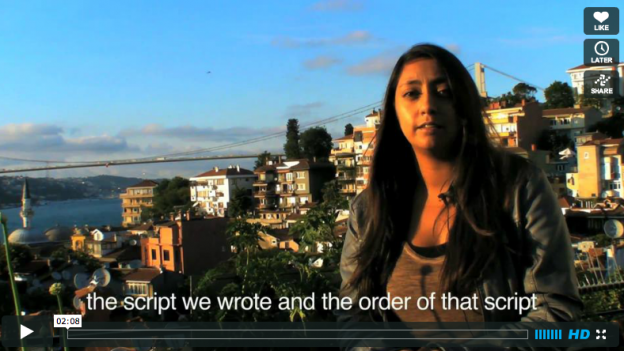
These videos are interviews with the artists. Read more about the people behind European Souvenirs.


FARAH RAHMAN (NL) Works as a video artist in audiovisual performances, creates photos, films and site specific art installations. Her work is often related to the Eastern philosophy Wabi Sabi, seeing beauty in imperfection. The re-use of materials, analog techniques and mixing them all together in the digital jungle is typical in her work. It has been described as audiovisual poetry, guerilla style. Next to her work as an artist she translates this style in project based assignments like publicity film/photography, workshop concepts, stop-motion animation.
Farah Rahman studied BA Audiovisual Design at the Willem The Kooning Art Academy In Rotterdam.


NORIKO OKAKU (UK) Noriko Okaku produces work in animated video, drawing, sculpture and audio/visual live performance. Her work in various media often retains a collage art element. She borrows, adopts, copies and recycles existing images to explore the diverse avenues of perception. Her work explores the eclecticism and mystery/strangeness underlying everyday objects and actions. Okaku studied Fine Art (Media) at Chelsea College of Art and Design before attending the MA Animation at Royal College of Art.
Her video work has been included in exhibitions at Hakobaka Gallery Kyoto, Asifakeil Museum Quartier Austria and Garage Center for Contemporary Culture Moscow.


KAROL RAKOWSKI (PL) Multimedia artist and director, producer, musician; philosopher by education. In his works, he deconstructs borders that separate media from artistic expression forms and exceeds limitations of the tools he is using. He is particularly interested in light and its role in the dramaturgy of a performance.
He collaborated with many artists, working in superproductions (like the project with Brian ENO for the Wrocław Fountain), as well as avant-garde projects.
He lives and works in Wrocław (Poland).


MALAVENTURA (ES) Based in Fuengirola (Malaga, Andalucia), Malaventura is the moniker of Fernando García Tamajón (Malaga, 1978) BA in Audiovisual Communications studies by the University of Malaga.
His work range from experimental electronic music, videoart pieces, multi-touch interfaces programming, random experiments with online movie editing or the “Audiovisual Sampler” artifact, a tool that make possible to launch movie clips in live action to create a live cinema show. Since the year 2000 delivering music & video works under open licences


BARIŞ GÜRSEL (TR) Media Artist & Director working on various motion graphics, animation and music video projects. Till 2011 worked as a compositing artist for many animation/vfx projects at Anima Istanbul. In 2012 co-founded his company Bench Studio in Istanbul. He is also working as a freelance compositing and motion graphics artist in Amsterdam.
Studied Interactive Design at Yıldız Technical University in Istanbul, and now receiving his MFA degree in VCD from Bilgi University. Through his own artwork he is attempting to examine the phenomenon of Biophilia (Human-Nature Relations) and Fiction/Fake.

Seville: broadcast Europe (a fictional story).

I’m Silvia Nanclares, and I write stories. Some stories, some blog posts, some scriptwriting, some articles. I always do it from an autobiographical, self-fictional point of view. Writing is almost the thing I most like doing in this world. I also coordinate Creative Writing groups, so I have spent some time studying the guts of stories in order to find some good ways of telling them (this varies, and depends on each story, but there are some general patterns: basic tools). People often ask me whether it is possible to teach writing, and I answer that I don’t know, but that my experience tells me that these tools, once detected and set in play, can improve a lot how your stories reach people. The skill to touch and awaken the interest of the other is something that requires a technique, indeed. This is the technique of narration. And this is what I expect, with the help of Nuria (Nuria G. Atienza, documentary film maker and coordinator of the education through audio-visual production workshops. Co-coordinator of the Narratives module within the European Souvenirs) and the team, to transmit to you: a few tools that can make what you want to tell reach your audience more efficiently.
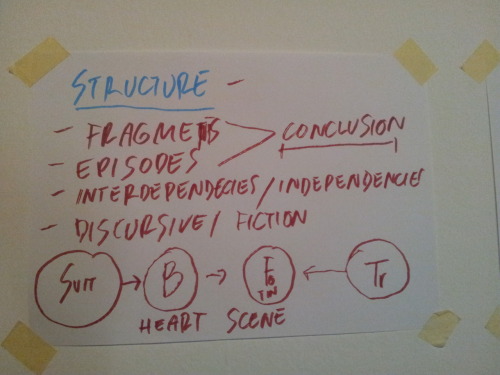
StructureStructure – Seville Residency. (cc) ZEMOS98

memory/archive
In auto-biographical writing, I use my memory as an archive on which to deploy the technique of fiction. This is how I document my life, so that it can stop being only mine. So that it can become anyone else’s. I use fiction in order to build a truth. Lacan said: Truth has the structure of fiction. Structure is one of the tools, if not the most important tool, that we will deal with these days. Truth has nothing to do with reality. Truth is built (and politicians know a lot about this) with techniques of fiction. Imagination as a political muscle at the service of the most disparate ideologies. But the collision between stories can also be put at the service of the liberation of ideas.

technique/fiction
After being put through the machinery of fiction, my memories (my life souvenirs) become literary motifs, re-combinable pieces at the service of the story I want to tell. Things apparently unordered and bereft of meaning are thus joined together in order to build fiction. My work is precise: it consists in creating a form (language, style, structure) premised on my memories, that can allow me to narrate ideas which can concern and touch other people. On the basis of something as apparently private and intimate as a memory, I try to cross the bridge over to the common, towards a possible identification.

aesthetics/content
To procure an aesthetic which can be at the service of, or contained within, an ethics. Form at the service of content. The mode in which I say things at the service of what I want to narrate. Technique at the service of narration. Narration at the service of the idea. When we deal with structure, we’ll see that ideas can also be protagonists in stories, and can have conflicts with each other that can configure a plot.

us/here
We are here to do something similar. To select re-combinable pieces from our personal archives (in this case, “national” archives, representatives of a “collective personality”, of a shared and common intimacy) that can allow us to build a common narrative which can appeal to anyone.

broadcast europe
I was brought up in a middle class area of the city of Madrid. My family is typical of Spain in the seventies, of Spain after the dictatorship. Three children, Mom worked as a housewife, and Dad left home in the morning to go to work, and would come back at night. My father ran a company that represented broadcast firms (it took me decades to understand this word), and used to travel a lot. He would travel abroad, look for equipment (cameras, editing tables and other products) in order to distribute them here, in order to provide a country (Spain), whose telecommunications system was booming during the 80′s and 90′s. My father defines himself as a technocrat. “I’m a man with no imagination”, he usually adds.

fetish objects
I’ve got a fetish object at home, which I could consider a family souvenir, from my father: this object here. This little notepad, where he would write down all the flights he took during over 40 years of professional career. A register. An archive of flights. This is my father, a very important part of him. He travelled a lot through Central Europe, the so- called Western Europe. Also to Japan and the USA, but above all Europe. He made us admire that Europe, his Europe: Germany, Holland, the United Kingdom, Switzerland, Italy. That idea of Europe is what I was brought up on at home. A buoyant, strong, technified and wealthy Europe. He would travel almost every month, and always brought back a present to each of us from the cities he had visited. That moment was a ritual in itself. The moment that Dad would put his suitcase on the table and rummage through the clothes in search of the bags with our presents. I especially remember his arrival from a long stay in Japan: kimonos for Mom, a bottle of sake, a Rubik cube, a Nintendo, some prints of geishas. Our house started filling up with souvenirs: German beer mugs, London double-decker bus magnets, Norwegian salmon, Swiss chocolate, t-shirts with typical national slogans.

stories
But there were also immaterial memories, his stories. Like that time that a man tried to seduce him on a train from Rome to Pisa (that was when there were ABSOLUTELY NO homosexuals in Spain), or that story of the only other Spanish speaker he ran into in Japan being a Chilean Pinochet-supporter, whom he couldn’t talk about anything at all without having a row. He would also bring us information and impressions from Europe, such as trains being on time, that at four o’clock in the afternoon it was already night-time, or about how people respected the queue at cash machines. The recreations of these stories and memories are what informed my first idea of Europe.

“in europe”
I once had a boyfriend who told me that on January 1st 1986 his mother woke him and his brothers up really early, dressed them up really well, prepared them excellent breakfast and sat the whole family in front of the TV to watch the ceremony of Spain’s entrance into the EEC (currently, the EU). Not long ago, I spent some time in France, and people would be very surprised to hear me use the expression “in Europe”. The fact is, I didn’t grow up feeling part of Europe, maybe that was because of political circumstances, and to that halo of otherness and idealization that my father’s stories, souvenirs and travels transmitted to me. For better and for worse, sometimes fiction can have this distancing effect.

1992
That year, I was seventeen, and had already started questioning the official family story. Barcelona hosted the first Olympic Games to take place in Spain, Seville was host to the Universal Expo, and Madrid was European Cultural Capital. It was time to introduce ourselves to the world. And to obtain all kinds of infrastructure; in a nutshell, to become European. For this purpose, we had a budget, called the European Social Budget. We have grown thanks to this budget. Which, by the way, is already spent. It’s like when your parents stop your allowance. In 1992, Europe and the world came to visit us, and we brought out the heavy artillery of stereotypes. We turned our souvenirs into a fashion: happiness, sunshine, the Mediterranean, colour, heat. It was madness. I remember the wooden Japanese Pavillion at the Expo; the heat would make the wood swell, and it had to be repaired halfway through the exhibition. Pavillion. This notion of a Universal Expo is totally pre-Internet, isn’t it? So is the idea of bringing or taking a souvenir from another country. Nowadays anything, except the immaterial, can be purchased anywhere. And what isn’t, is on youtube.

secrets
I’m under the impression that life beings in 1975, the year I was born. This is partly due to the fact that I was born on the final year of Franco’s dictatorship. The desire to forget is very strong. At home, my parents rarely spoke of their childhood and adolescence, as if by not mentioning the Post-War period, when cold temperatures and deprivations were a matter of everyday life, History would become blurred until vanishing. Who wanted to talk of other times, now that we had central heating, supermarkets filled up to the tip, and television with an MTV channel? But there were the pictures. One night, at my grandmother’s place (and this is a secret I’m first revealing here), while she was sleeping, I picked out and stole a whole bunch of pictures from her personal archive, called “the tin with the photos”. There were some pictures from their brief exile to France: the only “Europe” that my grandparents ever set foot on, and a family taboo. I felt that I had suddenly recovered a whole story which my parents’ silence had refused. The worst thing wasn’t me stealing these pictures, the worst thing was that, a few years later, after moving house a few times, I lost them. I have lost a part of my family’s memory. I’ve created a void on the basis of another void.

redefinition/fiction/remix/rendition
In order to fill this void, right now I’m writing a novel entitled broadcast, where I’m trying to redeem myself through fiction. In the novel, I’m trying to reconstruct, one by one, the stolen pictures I can remember, and to create a story with them. Like scenes, the pictures would lead into one another, until forming a new family history. False memories Truer than official history. That’s what I have, that’s what I know how to do: to fictionalise on the basis of memories. In order to attempt to rescue that which is irretrievably lost. From the private to the universal, passing through fiction. The autobiographical remix as a technique to re- write History, in this case, family history. This is how archive-based narrative works, like an imaginary broadcast, maybe closer to the truth than any documentary that pretends to be objective.

snippets/coast
with the snippets of Europe that kept arriving at my flat in Madrid I built my self an idea of Europe which was very much premised on progress in the telecommunications sector, with technological infrastructure as a safety measure, the Europe of the common market; a very Duty Free-like poetic. Also, a Europe with social rights. In 2007, I accompanied my father to IBC, in Amsterdam, one of the largest fairs in this sector. These are the pictures I took in Amsterdam (see Flickr set), what I found interesting there. The Jordaan quarter. A pink intercom. The terrace of a bar. An antique market. One of the few times I could stroll around the fair, my father looked at my with an expression of fascination, and told me he wanted to show me something. He took me to the back of the buildings, walked past a few giant broadcasting trucks, and showed me this (photo of connected cables). A mesh of cables that made life and communication possible for the stands indoors. That was what my father found fascinating. Communications. Cables. Connections. Machines. Perplexed, and with a dose of irony, I took note of the narrative and vital abyss that separated us. But I also felt the many bridges that united us, especially those of affection. Whether we like it or not, we are attached to many stories that don’t quite represent us, but that have made us who we are.

memory/identity/voice
What we choose to remember, to register, that which fascinates or repels us, determines our memory and the identity that we assign to things and to places. Mi current narrative on Europe (based on my own memories and ideas) has been inexorably affected by this paternal image of fascination with the cables, and we could almost say that it was forged in opposition to it. The childhood/juvenile/family narrative of the progressive, merchant, technological Europe was my point of departure from where to locate myself in the “global world”. My notion of Europe owes a lot to the narrative of Europe of my father: patriarchal, productivist, and social-democrat. And this is neither good or bad, it’s a fact that must be recognised. It is crucial to be aware of what memory we are starting off from, and what other kinds of memory or struggles of memories we want to voice with our stories. The selection we will make from our own archive, the voices and versions of the stories we would like to host in our collective narrative will constitute, by themselves, a fairly politically-charged gesture. The contents and final aesthetic of the memory we build will speak for us.

some code, please
with this fictional-talk, I have attempted to appropriate the issues posed by the European Souvenirs project: how can memory and official narratives condition identity and how it is important to give a voice to other, non-subsidiary representative memories. I have problematised the idea, by running it through my own experience, and creating a certain fictional texxture, since that is my knowledge methodology. In order to share it, I have put on the table and revealed my life experience, my memories, my souvenirs and the ideas that have been prompted by them, with the aim of creating a story.
I invite you to appropriate some of the issues launched by this project: choose subject matter you’re interested in, that transverses you or that appeals to you individually or as a group, from your individual, everyday point of view, in order to later be able to pay full attention at building the bridges that will weave a common code and will build a collective story with the capacity to emotionally and intellectually touch any spectator. each story develops its own code. and that code is only revealed while the story is being told. it’s not something you can do a priori. so, let’s get started…
For some time, Silvia Nanclares, has been going back and forth between playwriting, screen plays, critical fiction, albums for children and short stories. She studied Theater and Drama at the the Royal School of Dramatic Arts (Madrid). Two of her plays Diet (2001) andLittle Brothers (2002) were published in 2001 and 2002. Her first collection of short stories, The South: A User’s Manual appeared in 2009 and she is currently finishing her second collection. She has also written two books for children The Nap (2000) and At the End of (2010), both published by Kókinos.

She is also a living, breathing person and meanwhile, she manteins her blog.

This work is licensed under a Creative Commons Attribution-ShareAlike 3.0 Unported License.

This text is part of the material which European Souvenirs artists were working on the first residency, at Seville. More about European Souvenirs.
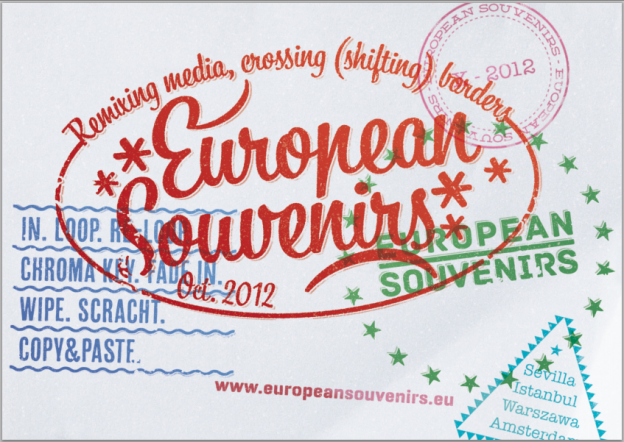
Featured theme: Crossing Shifting Borders.


Crossing shifting borders – In the next weeks Doc Next Network focusses on the mainstream imagery of IMMIGRATION IN EUROPE, still largely dominated by ‘traditional’ media like public and commercial tv, radio and newspapers. In September and October 2012 Doc Next Network sheds an alternative light on traditional imaginary, by bringing forward local contexts and the personal perspectives of immigrants to the wider European stage.

Each two months Doc Next Network share videos, articles and more around a certain topic or theme that is close to our goals and believes. We want to engage young people, NGO’s, policy makers and mainstream media in the collection (of documentary activities of young people from Europe) so that the voices and views our makers can be heard, listened to and acted upon.

CROSSING SHIFTING BORDERS is Doc Next’s first featured theme. You can find all past en present featured themes here. Please visit our Facebook Page to get more involved in CROSSING SHIFTING BORDERS.

We invite you to add content! If you want to contribute, please mail your videos, calls, articles or photos to Puck de Klerk.

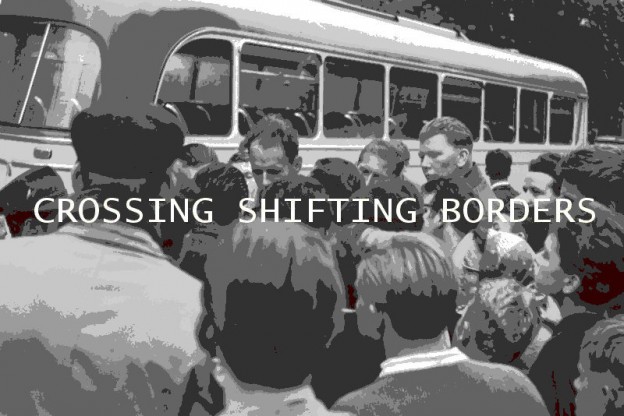
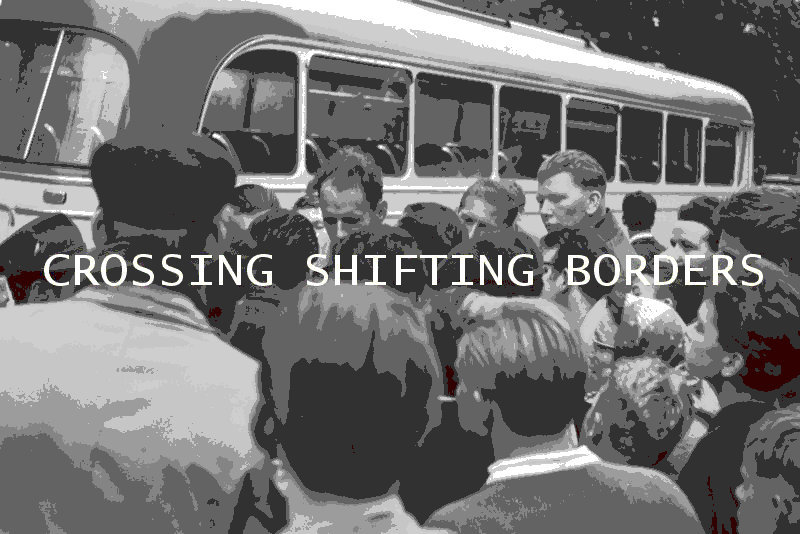
The picture above shows Italian immigrants arriving in Oldenzaal (1961, The Netherlands) from the Dutch National Archive.