Matthew Cuzner

About Matthew Cuzner

Matthew Cuzner graduated in Drama, Applied Theatre and Education at the Central School of Speech and Drama in London, the United Kingdom. Originating from a predominantly theatre-based background, Cuzner has performed and facilitated many workshops for young people. Currently, Cuzner specifically works on the Doc Next Network activities on behalf of the BFI (British Film Institute). 
 ROLE: facilitator.

Author Archives: Matthew Cuzner

Matthew Cuzner

About Matthew Cuzner

Matthew Cuzner graduated in Drama, Applied Theatre and Education at the Central School of Speech and Drama in London, the United Kingdom. Originating from a predominantly theatre-based background, Cuzner has performed and facilitated many workshops for young people. Currently, Cuzner specifically works on the Doc Next Network activities on behalf of the BFI (British Film Institute). 
 ROLE: facilitator.

Book European Souvenirs now!

Delving into audiovisual materials from leading European archives, Doc Next Network brings you European Souvenirs that offer a trip down memory lane. Remixing music, photography and film, the European Souvenirs artistic group re-examines the prevailing imagery of immigrants across European communities and re-maps Europe visually, geographically and conceptually.

European Souvenirs is a major live-cinema performance by artists Karol Rakowski (PL), Barış Gürsel (TR), Farah Rahman (NL), Malaventura (ES) and Noriko Okaku (JP/UK).

European Souvenirs tours in different countries across Europe and beyond. You can book the show for your own event or venue now! Download the folder including the booking conditions and contact information by clicking on the image on the right.

This video shows 15 minutes of European Souvenirs. The original length of the performance is 50 minutes. More…

Aha! This is Remapping Europe!

We all like stories. We create them. We consume them. We distribute them. And we remix them. Today, I have a little story to tell you about Remapping Europe.

A lot of time, the most interesting things that happen around proffesional and cultural projects are the unexpected and unplanned things. Yes, you usually have a budget, meetings, agendas, dates, workplans, teams, tasks, documents, emails and of course, stressful situations.To be very brief, Remapping Europe is an international project run by  Doc Next Network, to create and share stories to rethink our european identity. We want to work with migrants to ‘re-map’ Europe visually, geographically and mentally. But as you can see (and feel), this is the official definition. And of course, I can tell you a lot of things from this perspectives (because believe me, in the Doc Next Network, we love to open new documents. We are on the very brink of crashing Google Docs). So, this morning, I experienced something that showed me a personal and unofficial definition of what Remapping Europe is.
ahmed

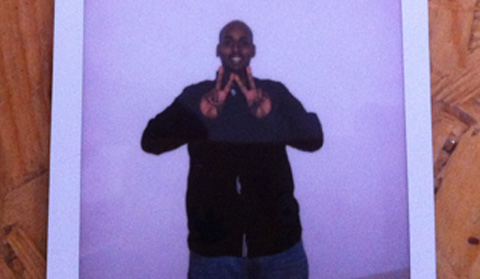
This is Ahmed. He was born in Somalia but he is living in London. His father was very lucky: in Somalia, someone working at the BBC there who could get out people of the country organized a kind of job-offer to get out 3 people from there. There were a lot of people who wanted to leave the country. Ahmed’s father was one of these.

Ahmed studied Filmmaking in London. Now, he is in contact with the Refugee Youth organization, based in London. And now, this organization is collaborating with the British Film Institute (one of the hubs of the Doc Next Network). He will be one of the “Travelling Participants” in Remapping Europe. His responsibility is to travel to every country (Poland, Turkey, Spain) and to be the storyteller of these experiences to the rest of Refugee Youth.

I met him yesterday. It was the first workshop of Remapping Europe in Warsaw. We had to make a game to present ourselves. We were in pairs, and we had 15 minutes to tell our story. Then, we had to present our partner to the others and take a photo of him/her. It was in the moment that Ahmed told us that he has two kids, and in the photo you’re watching he is imitating one of his kids making a “double-sign-of-peace” with his hands.

But it was this morning when I really felt “Ok, this is Remapping Europe”. We were having breakfast. When you are not an anglo-parlant, it’s the worst moment of the day because your english-skills are still sleeping. But then we started a conversation about free culture. And I was myself again, explaining the main core of Free culture, the Creative Commons licences, what the public domain is, etc. And then we connected with the african oral tradition of Ahmed.

And there we were: a Canary guy with French and Andalusian roots (and maybe it’s my intuition, with Phoenician ancestors) talking about free culture with a Somali guy living in London, in the middle of the snow in Warsaw.

I know that maybe it sounds naive, but for me, I realised in this moment that it’s part of my work. But it’s also part of my life. Because we were remapping europe.

By Abrelatas from ZEMOS98

Abrelatas says: Thankx Matt, for helping me with my English!
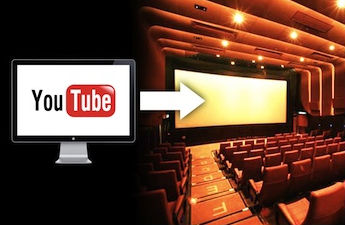
Upload Cinema: taking webvideo out of the domestic realm.

sfeerbeeld-publiek.jpgThe web is changing film. Not only the way film content is being distributed, but also the way film is being produced and watched. The whole interactive process of making, mixing, choosing, uploading, commenting, recommending and reacting is what is truly revolutionizing the industry.
Film is becoming more and more a collaborative, social activity. But unfortunately this activity is taking place behind the computer at home or at work. Which is, let’s face it, not the best possible place to enjoy movies. Film is becoming more and more a collaborative, social activity.

Upload Cinema wants to take this exciting new way of making and sharing film out of the domestic realm, away from the internet and the tiny computer screen and into a space that’s designed for a collective experience: the cinema. Upload Cinema brings the best internet videos to the big screen. Every two months they present a fresh, thematic program of captivating web films, linked to a special theme. The audience submits web films; a team of editors picks the best ones and compiles a programme of around 90 minutes from the bunch, which is screened in cinemas and on special locations.

Win 2 tickets for The Best Webvideos (Amsterdam, 29 January) 2012 on Facebook.

Upload Cinema celebrates the new year at the Stadschouwburg in Amsterdam (Tue 29 January). Lean back and enjoy the most shocking, funniest and best online videos of 2012 on the big screen.
Doc Next Network’s partner Metropolis TV is this years guest editor! You can win 2 tickets for the event on our Facebook Page.

Buy your ticket here.
More about Upload Cinema here.

YouTube-Screen.jpg

New Doc Next Theme: Interactive Storytelling.

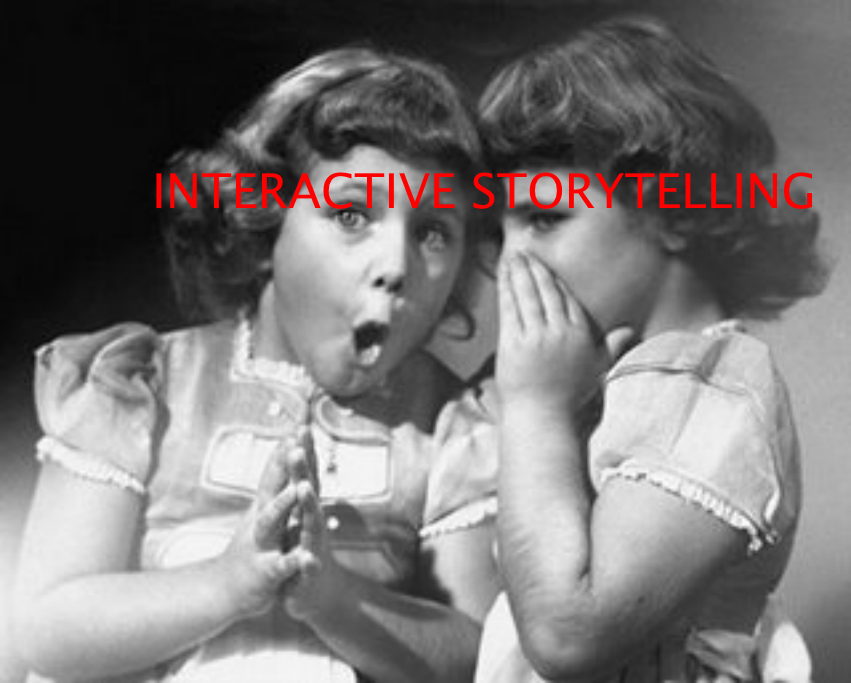
Introducing a new Doc Next Network featured Theme for December and January: INTERACTIVE STORYTELLING.

At a time when interactivity is redefining the documentary landscape, Doc Next Network, as a movement committed to reimagining the notion of “documentary”, tackles the link between digital interactive technologies and documentary making by zooming in on interactive storytelling practices.

Promoting documentary as tool for communication as well as documentation, and forming a link between traditional media and the constantly developing world of free culture, Doc Next Network investigates interactive storytelling as a new model of exchange between young creators, providing them an alternative space to be inter-active, inter-participatory, and inter-dependent. 

Essentially, the interactive multimedia capability of the Internet provides documentarians with a unique medium to create non-linear and multi-linear forms of narrative that combine photography, text, audio, video, animation and infographics. Beyond that, with the development of new authoring tools, with HTML5 and open video possibilities, media makers are getting enabled to create a wider range of experiences and personal ways for the networked audience to tap into the narrative sphere of a documentary, giving them an active role in the negotiation of ‘reality’.

With the Do-it-with-Others (DiwO) approach deeply ingrained in our network, we believe these practices help the new generation of media makers create meaningful, socially engaged stories in a participatory framework by introducing new ways of interaction, conversation and sharing of ideas between and among their different communities, allowing them to compare the realities of different worlds and ultimately to present in novice ways alternative perspectives on contemporary Europe and beyond.

Social justice through free culture and expanded (media) education.” This is what we seek to promote and accomplish through our work as Doc Next Network. We welcome, investigate and help construct new approaches, methods and tools of storytelling to do just that.

The theme of Interactive Storytelling will run until mid January 2013.

Doc Next photographer (18) premiers in Warsaw gallery.

18 year old Karol Komorowski is now premiering his  work at the Lookout Gallery in Warsaw, Poland. Karol is a talented photographer representing the youngest generation, standing on the threshold of his caree. His exhibition ‘Debiut’ consists of two projects: In the Dark and Girls.Karol Komorowski is one of this year Polska.doc participants – a programme run within Doc Next Network’s framework.

Read more about Karol Komorowski exhibition at polska.doc.e.org.pl and at the website of Lookout Gallery.

All images on this page are by Karol Komorowski.

Doc Next @ IDFA 2012

Doc Next @ IDFA 2012 brings fresh short documentaries by young European D-I-Y media-makers to the big screen. Their portrayals of everyday heroes reveal small, sympathetic, local actions that have a big impact. About the love for storytelling, dancing, coffee, birds, personal belongings, memories and gardens… What are the images of Europe that they reveal? Doc Next @ IDFA mixes patient-eye documentaries with critical and political remix videos.

View the play lists here.

Doc Next @ IDFA is an initiative of International Documentary Film Festival (IDFA) and the European Cultural Foundation (ECF), based on a mutual desire to make sure the voices of young D-I-Y media talent are included in public opinion.


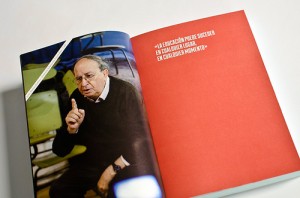
ZEMOS98 PUBLICATION ABOUT EXPANDED EDUCATION.

In 2009 the ZEMOS98 Festival (partner in Doc Next Network) investigated the alternatives for formal education and other ways of expressing knowledge. 

This process, in which activists, educators and people from the cultural and social innovation sector participated, took place in the context of the international workshop ‘Educación Expandida’ (Expanded Education). That results were collected and documented on www.educacionexpandida.org, and have served as a starting point for a publication.


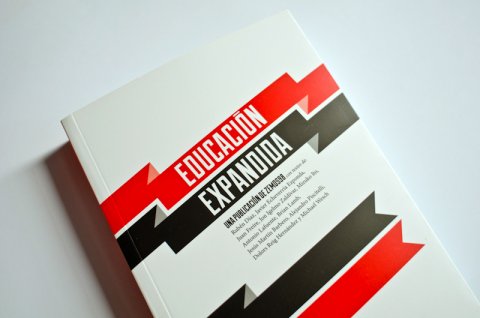
The book ‘Expanded Education’ –subtitle: education can happen anytime and anywhere- holds proposals for informal education, social activism and research in participatory processes. Expanded education is a concept that has been aknowledged by institutions and groups from various fields. To ZEMOS98, the greatest achievement isn’t the publication of the book itself, but continuation of the investigative process that began in 2009: ZEMOS98 wants to contribute to the development of expanded education by investing in anti-authoritarian and non-directional projects and methodologies.


Read more about the book here: http://publicaciones.zemos98.org/educacion-expandida-el-libro (download in PDF available)

Institutions changing for the better.

This post Innovation and institutional change for the reinvention of democratic practices (Imagining Europe) is written by Juan Freire and was originally posted on nomada.blogs.com.

imagining_europe_jfreire_1I participated recently in the event Imagining Europe organized by the European Cultural Foundation in Amsterdam. Specifically I was part of the roundtable and debate Reclaiming Public Space – Democratic Practices Reinvented? where we tried to put “[d]emocracy in Europe under the microscope” (here a resume of the activities of the day).
Farid Tabarki (founder and director of Studio Zeitgeist in Amsterdam)  was the moderator of the debate involving Peter Vermeersch (lecturer, poet, G1000 Belgium), Tiffany Jenkins (sociologist and cultural commentator, UK) and myself to explore alternative models for democratic practice in Europe. My intervention was focused in “Innovation and institutional change” trying to present ideas about these two questions:

  • How do the alternative models [organizations and processes based in bottom-up and networked dynamics] connect and / or collide with traditional political and cultural expression?
  • How can new initiatives develop sustainable and long-term ways of participation without losing their innovating character?

The following images (the set in Flickr; see credits below) and notes is a mostly visual resume of my ideas, that I prepared after a conversation with Farid Tabarki (that inspired and provided me with clever ideas):

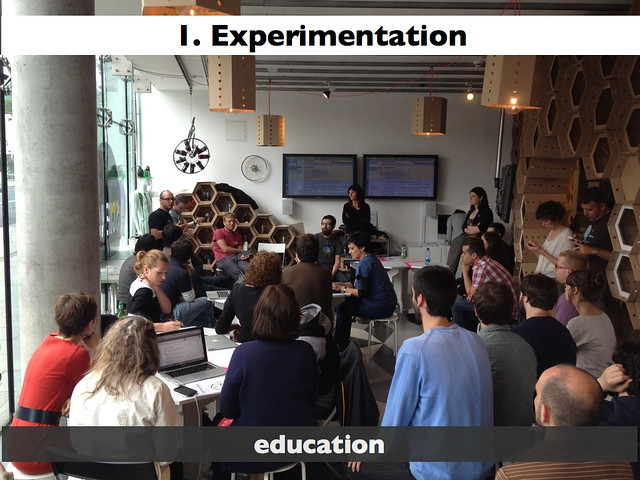
imagining_europe_jfreire_2

The new models of organizations and processes based in bottom-up and networked dynamics should be consideredexperimental. The only way to innovate and learn how to make effective the new practices and structures is to make them real and explore their possibilities. This means also that we need to allow failures as the only way to get real innovation. From my point of view, we should look especially to experiments occurring in two fields. Traditionaleducation is suffering a long-lasting crisis but many alternative models based in learning by doing and collaboration are emerging. Also, education is overpassing its traditional limits to be part of the agenda of culture, science or business; thelab is the new concept of space for experimentation, prototyping and learning.

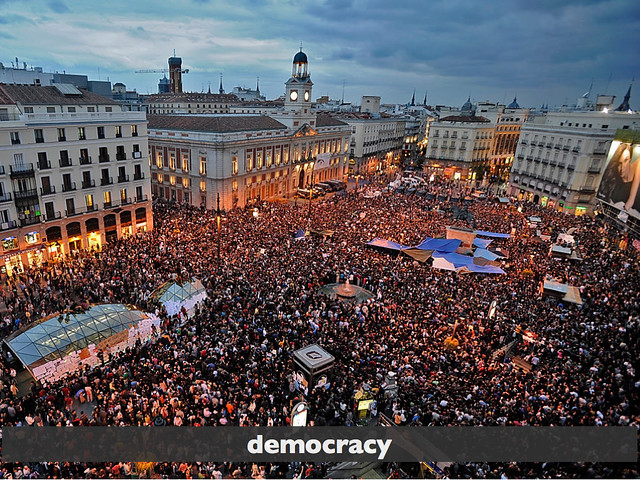
imagining_europe_jfreire_3

Political activism is other area of intense experimentation. Citizens are using technology and public spaces to organize themselves to discuss and make politics, sometimes in conflict with the traditional politics (represented by institutions and political parties), sometimes opening new opportunities for dialogue. The novelty here is the large scale and diversity of the citizen-driven actions taking place from 2010 worldwide (from Arab revolutions to #15M or the Occupy movements or to activism occurring in Israel or Chile to put only a few examples). These civic movements need spaces for communication, deliberation and collaboration and in this sense are reclaiming the re-appropiation of the public space by citizens.

imagining_europe_jfreire_4

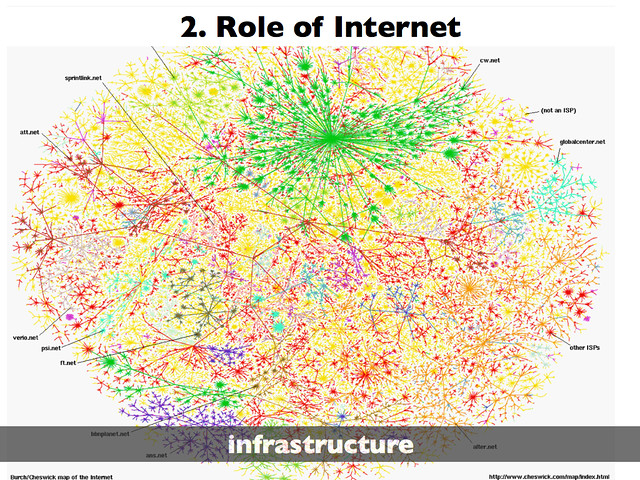
Alternative models could be not understood without the role of the Internet. They are not only digital phenomena; most of them are eminently analogical processes. However the Internet is a key element at least from 3 points of view. First as an infrastructure that allows the new network organizations and processes to be effective at a large scale.

imagining_europe_jfreire_5

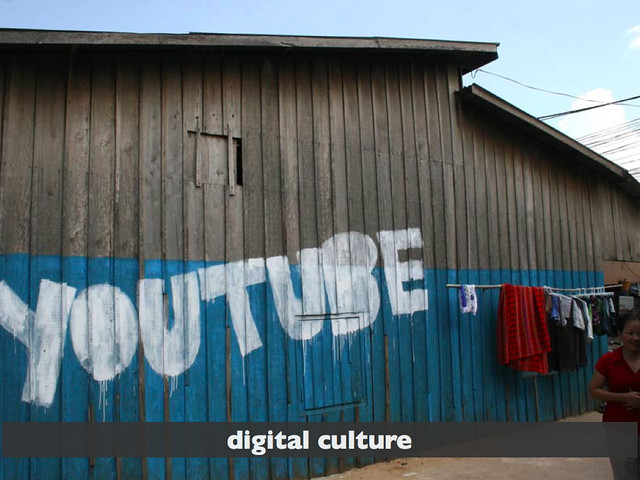
Second, the Internet has been the driver of the re-emergence of new practices and values, a new digital culture based in ideas as openness, peers, commons or collaboration and the rethinking of intellectual property.

imagining_europe_jfreire_6

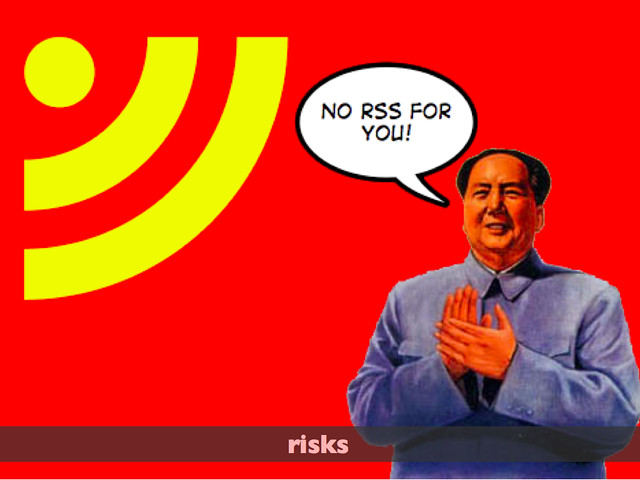
However the Internet is also a risk for these emerging phenomena because it is also a powerful tool for the power to try to control citizens, especially, but not only, in non-democratic countries. This is the other side of the impact of the digital; the balance between the pros and cons is not decided and will depend of the active roles of the different stakeholders.

imagining_europe_jfreire_7

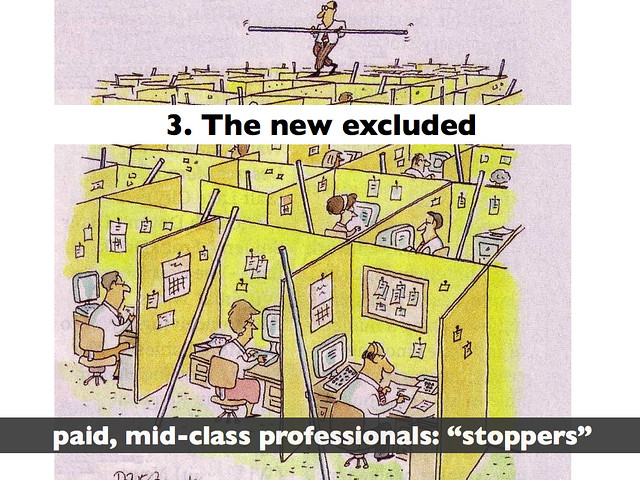
The new scenario changes the roles and outcomes of the different social collectives. In one side, probably a new class of excluded is emerging that it is very different from the traditional ones. The mid-class professionals usually working for big corporations and institutions are in many cases unable to understand and participate in the new models and as a consequence act as “stoppers” trying to keep their world as usual.

imagining_europe_jfreire_8

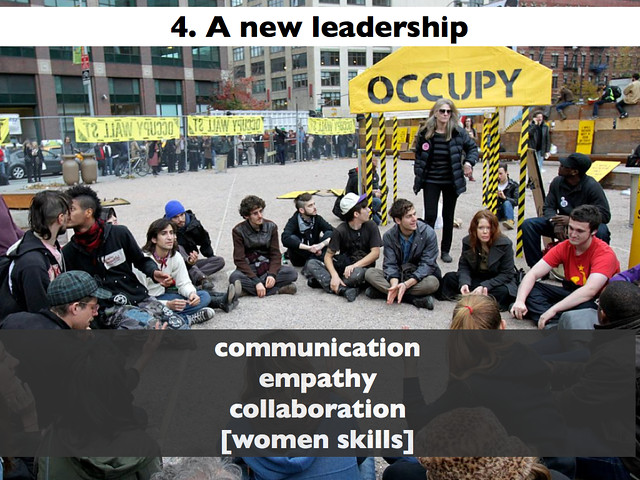
Networked organizations are open and flexible but leadership continues to be necessary. A new kind of leaders emerge with skills different to the leaders of the past. They need to communicate using new media and empowering social networks. They have to develop empathy with the different stakeholders. Finally most of their work is behind the scenes making things happen and, in this sense, promoting collaboration and team work. New leaders are obviously women and men but in many aspects their skills and values are much more close to those that traditionally were assigned to women.

imagining_europe_jfreire_9

New models are working well at the small scale in the sense that we are getting many learnings and insights from these political experiences. However they attained large scale only during short periods as reactions to extreme situations (as dictatorships in the Arab revolutions) or as sophisticated demonstrations in democracies; but they have no transformed the political system. In contrast in the last decades digital processes have been able to attain large scales (i.e. Wikipedia or the free software communities) transforming for example the production and distribution of knowledge. The main question for the future is how to scale up political processes and organizations. We need dialogue between the traditional representative democracy and the new deliberative and participatory politics. Now in most cases they are operating in different channels and the conflicts continue to be manageable because of the scale, but with increasing complexity new consensus, organizations and institutions are needed and they could only emerge as hybrids of the remix of the old and new ones.

imagining_europe_jfreire_10

An agenda for transformation needs to identify why, how and what is changing for the better, and to look for a common ground where the new and old processes and institutions could collaborate.

Credits of the images:

  1. Science Gallery (Dublin), workshop in collaboration with Medialab Prado (June 2012)
  2. http://nosoloilustracion.wordpress.com/2011/10/16/cronica-de-un-cambio-anunciado-15m-15o-spanishrevolution/
  3. http://www.cheswick.com/ches/map/gallery/index.html
  4. http://www.psfk.com/2008/12/digital-culture-snub.html
  5. http://censorshipinamerica.com/2011/10/20/china-defends-internet-censorship-against-us-trade-query/
  6. http://vlb.typepad.com/commentary/2006/03/realtime_produc_1.html
  7. http://cryptome.org/info/ows-19/ows-19.htm
  8. http://flowerwatch.net/2010/02/08/how-natures-complexity-is-simple-and-natures-simplicity-is-complex/
  9. http://www.masshumanists.org/changing-for-the-better.htm

Live preview and Q&A for press and cultural innovators.

THE LIVE SHOW IN THE EVENING IS SOLD OUT. However, journalists, bloggers, new media industry representatives and cultural innovators are cordially invited to attend the live preview and Q&A of European Souvenirs. Saturday 6 October, 17.00. De Balie (Leidseplein), Amsterdam.

Delving into audiovisual materials from leading European archives, Doc Next Network brings you European Souvenirs that offer a trip down memory lane. Remixing music, photography and film, the European Souvenirs artistic group re-examines the prevailing imagery of immigrants across European communities and re-maps Europe visually, geographically and conceptually.

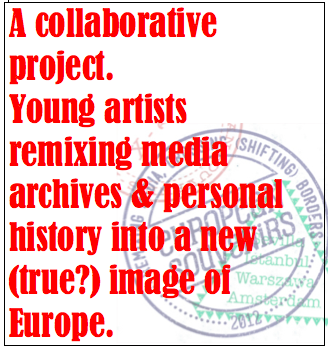
European Souvenirs premiers on Saturday 6 October at 20.30 – this major live-cinema performance will tour afterwards in different countries across Europe and beyond. The collaborative multi-media project is created by artists Farah Rahman (The Netherlands), Karol Rakowski (Poland), Barış Gürsel (Turkey), Malaventura (Spain) and Noriko Okaku (Japan/UK). Universal concepts such as ‘family’, ‘travel’, ‘borders’ and ‘memory’ are the starting point for their expedition. Read more about the artists…

European Souvenirs uses remix techniques: the artists take on the precepts of contemporariety as proposed by Marcel Duchamp and his ready-mades. The copying, manipulation and representation of the real includes images from films, DVDs, video clips and video games. The artists mix their own childhood memories with audiovisual material from leading European institutions that have opened up their archives for this project. Remixing Europe implies to build a sort of Frankenstein made up of different cultural baggages.

For accreditation for the Live preview + Q&A with artists, please RSVP below. The number of places is limited. You will receive a confirmation by e-mail before 4 October 2012.

For all press inquiries about this Live preview, please contact Daniel Bouw: daniel[at]deneuve.nl. 
For other information about European Souveniers, please visit this website.

[contact-form-7 404 "Not Found"]


Call for Dutch Do-It-Yourself film-makers.

Doc Next @ IDFA: Open Screen for Dutch Do-It-Yourself film-makers.

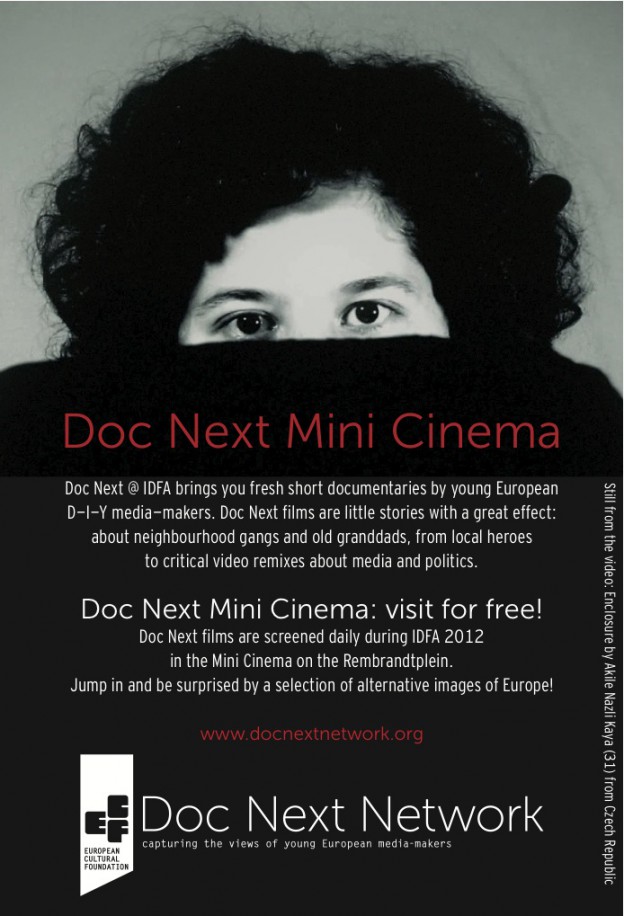
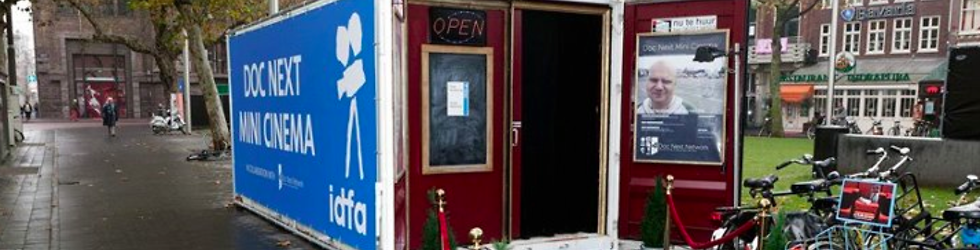
Are you a young Dutch film-maker? Have your your best work screened in the Doc Next Mini CInema, at the International Documentary Film Festival (IDFA) 2012!

Doc Next Network calls for short video documentaries, made by young (< 30 years old) Dutch film-makers, within the theme LOCAL HEROES. Share your work in this group to enter our Dutch Open Screen.
A selection is made by a professional jury and will be screened at IDFA 2012 (15 – 25 November), in the Doc Next Mini Cinema situated in the heart of the festival at the Rembrandtplein, Amsterdam.

This years theme is LOCAL HEROES. We are looking for self-made videos, documentaries and reports about people & symbols that inspire and provoke you.

Doc Next @ IDFA is about an alternative perspective on Europe, do-it-yourself and free culture. The Dutch Open Screen is open to any young film-maker (younger than 30 years old, no need to be officially educated) living in The Netherlands. Upload your film in this group. Add your name, age and a short description. Deadline: 1 November 2012.

-Selections for the MinI Cinema will be made by a jury with members of IDFA, Doc Next Network, Metropolis TV and Holland Doc;
-The selection will be announced on 15 November 2012;
-Films that are NOT in English or Dutch should be subtitled;
-Entries remain property of the maker but can be used in any means of communication by the European Cultural Fondation, Doc Next Network hub partners, Metropolis TV and Holland Doc;
-The Dutch Open Screen @ IDFA is a one-off event. The organizers do not commit themselves to follow-up activities;
-By entering the Dutch Open Screen makers make themselves aware of Doc Next Network and its goals (www.docnextnetwork.org/about);
-Entering the Dutch Open Screen is free of charge. When selected for screening, there is no (financial) compensation;
-The exact date and time of the screenings will be communicated on www.docnextnetwork.org.

We have 2 IDFAcademy accreditations for Dutch DIY documentary makers who enter their work in Dutch Open Screen. From 15 until 18 November 2012, the IDFAcademy offers an intensive four-day training program for emerging filmmakers, producers, and film students. Full programme online here.


Get inspired at www.vimeo.com/groups/docnextnetwork!


hier wil ik de inhoud van simple user listing